One-on-One
How food insecurity is connected to the economy
Clip: Season 2026 Episode 2938 | 10m 23sVideo has Closed Captions
How food insecurity is connected to job creation and the economy
Steve Adubato and One-on-One Contributor Mary Gamba talk with Barbara Mintz, Registered Dietitian Nutritionist and Social Impact and Community Investment at RWJBarnabas Health, about the importance of addressing food insecurity as a means to create jobs and strengthen local economies.
Problems playing video? | Closed Captioning Feedback
Problems playing video? | Closed Captioning Feedback
One-on-One is a local public television program presented by NJ PBS
One-on-One
How food insecurity is connected to the economy
Clip: Season 2026 Episode 2938 | 10m 23sVideo has Closed Captions
Steve Adubato and One-on-One Contributor Mary Gamba talk with Barbara Mintz, Registered Dietitian Nutritionist and Social Impact and Community Investment at RWJBarnabas Health, about the importance of addressing food insecurity as a means to create jobs and strengthen local economies.
Problems playing video? | Closed Captioning Feedback
How to Watch One-on-One
One-on-One is available to stream on pbs.org and the free PBS App, available on iPhone, Apple TV, Android TV, Android smartphones, Amazon Fire TV, Amazon Fire Tablet, Roku, Samsung Smart TV, LG TV, and Vizio.
Providing Support for PBS.org
Learn Moreabout PBS online sponsorship(upbeat music) - Recently, my colleague on "Lessons in Leadership," our sister program, Mary Gamba and I, sat down and talked with Barbara Mintz.
She is a registered dietician, nutritionist, and Senior VP of Social Impact and Community Investment at RWJBarnabas Health, a longtime underwriter of public broadcasting.
We talked about food insecurity, SNAP benefits, right?
What is happening to replace those SNAP benefits that have been cut.
And, also, the impact on nutritious food, I can get that out, and people's health.
Barbara Mintz.
Check it out.
Mary and I are thrilled to be joined by our good friend, Barbara Mintz, Senior Vice President, Social Impact and Community Investment, RWJBarnabas Health.
One of our longtime partners and underwriters.
Barbara, tell everyone your background in nutrition.
What it is.
- Yes, I'm a registered dietician.
I've been doing this work now for 20, 25 years.
Started out at Newark Beth Israel Medical Center as a nutrition counselor and then kind of worked my way through some of what we're seeing today, which is the social determinants of health.
Specifically, food insecurity.
- Let's talk about food insecurity.
How serious is the issue?
And what is RWJBarnabas Health doing to address it?
- Well, it certainly is one of the social determinants of health that is most closely linked to our health outcomes.
I mean, many of the diseases that we're seeing in our emergency rooms and in our primary care offices are linked to food intake.
Diabetes, heart disease, obesity.
All of those things are related to what we choose as food.
However, if we don't have access to healthy food, we're not going to be able to really address those things in our own health and wellness.
So what we do, as a system, is try to look at food insecurity and nutrition insecurity at the same time.
I guess most people just look at it as a lack of food.
But it really is not just a lack of food.
It is a lack of healthy food.
So, with that, you have to be able to provide access to this healthy food.
So, as a system, we address the issue at its root cause, which is making sure that we do have access through developing models, business models and distribution models, for food, healthy food, vis-a-vis farmers, et cetera, to get into the places that it's needed the most.
Because food insecurity really is not just, it's not the lack of food per se, especially in the Garden State here.
It is the lack of the ability to get it to the places where it needs to be the most.
- Absolutely.
Mary, jump in.
- Barbara, you talked about the farmers.
And you talked about a whole network, a cohort of people that come together.
That raises a question that you and I had talked offline a little bit about, which is Harvest.
And the little bit that I know about it is super inspiring.
It's a collaboration.
It's bringing together people.
It's partnerships.
Steve and I talk on "Lessons in Leadership" all the time about the importance of partnerships and bringing people together.
Can you tell us what Harvest is and the partnership that you are helping to collaborate with them?
- Well, Harvest is a kind of a way to pull all of this together.
It provides, not only a place to aggregate and distribute this food, because we are in partnership with farmers, over 30 of them, throughout the state of New Jersey, but it's also a place to incubate businesses.
Food businesses, if you will.
It's right on Halsey Street in Newark.
And we will be able to connect with local restaurateurs, and entrepreneurs, and culinary artists in those spaces to bring their expertise into the city of Newark as well as develop a business model for this particular situation.
So we also have a teaching kitchen, which will allow us to bring in a registered dietician to come in and teach the reasons why we should be choosing healthy food and how to cook it, so to speak.
It really does, to me, as somebody who has been doing this work for a while, bring together the three critical partners that you mentioned, Mary.
One of them is agriculture, healthcare, and education.
Without those three together in this perfect trine, we're never gonna be able to move the needle in this space.
So this gives us an opportunity in not that big of a space, about 8,500 square feet, to really pilot this effort, if you will.
Get our farmers connected to a good business model.
Get our folks connected to the proper nutrition education as well as help the local businessman.
- I'm gonna follow up on this.
The SNAP Navigator program.
What is it?
And why is it so important, Barbara?
- Well, it's a program that we started with the Department of Family Development last year.
I think we're the only healthcare system in the country to do something like this and take this on.
But we've hired 12 staff navigators and two managers of these navigators to actually embed themselves in the communities within our catchment areas in all of our 12 acute care hospitals.
So this model's different because they're not only connected with our community health worker program, which is an inpatient model, if you will.
Those folks are embedded in our emergency rooms.
So they could get to connect with those who screen food insecure.
But these folks are deployed to community partners.
They're in churches.
They're in schools, local bodegas, supermarkets, et cetera.
Just to make sure our community members, whether they're our patients or not, are connected with this important benefit.
SNAP is really also an economic driver- - That used to be called, I'm sorry, Barbara.
It used to be called food stamps, right?
- Yes, they did.
Now, it's Supplemental Nutrition Assistance Program.
That's what it's called.
- Right, and connecting people.
I'm sorry for interrupting, Barbara.
But connecting people.
- It's okay.
- Good.
That's so hard.
'Cause people are like, where do I go?
And you're helping them do that.
Talk about that more.
- Yeah, so I think since RWJBarnabas Health is a trusted source for many things in health, having us in there as a navigator helps connect them to the social services.
Not just the clinical services.
So it really does- They know to come to us and all of our community partners within our local community.
So it's a corporate-driven initiative.
But it's locally implemented.
I mean, very hyper locally implemented.
So we work with our community health leaders in each one of the facilities to make sure that they are reaching out to folks who, and letting them know that we are here, and we can get them an application, and get them on their way to receiving SNAP.
- Navigating the governmental process to get the services one needs.
Easier said than done.
Go ahead, Mary.
- Barbara, you talked about access and you talked about education.
And those two, in my mind, because the access of the fast food, of the, every day you turn on the TV, there's a new $5 meal.
There's a new $3 meal.
I'm like, how do you get all this food for only $5?
How are you moving that needle that you talked about earlier when it comes to helping individuals to understand the difference between fast food, right, a $5, $6 biggie bag, whatever they are, and having access to that healthier food?
How do you help to change that dialogue?
Because I know, for me, it tastes really good.
- Yeah, unfortunately it does.
It's almost predatory in nature if you look at some of the underserved areas.
(Steve laughing) It is.
I mean, it's cheap.
- It's so good.
- And it's like, if a mom is really struggling, she's working a job and two jobs, and has all of these kids, and she needs to feed them, she can go right through a drive-through and get all of this unhealthy food at a very affordable price.
So we try to help folks navigate that environment, if you will.
We have many curriculums.
One of them is our KidsFit program that teaches kids and their families how to make better choices within this environment and also how to shop with their SNAP.
So if they go into a supermarket and they pick the right ingredients for a healthier meal, it could also be affordable to them.
Also, understanding that, sometimes, time is a huge issue.
And it's not easy to prepare meals for kids if you're working in, and even if we weren't living in an underserved area, it would be a difficult thing to do.
So to really drive that home at an early age with family members does help them to understand that there is a connection between how they feel, how they perform in the classroom, or on the playing field, or at work with the food that they're eating.
- Before I let you go, Barbara, what is a food pharmacy?
- A food pharmacy is not your typical food pantry.
It is a clinically integrated model that actually provides, not only healthy food access to those who screen food insecure, but also consultations with a registered dietician.
They get referred by their primary care or their specialty doctor.
They can go meet with a dietician and get access to healthy food in a very dignified, supportive manner where they will be shopping with a dietician to get their food, healthy produce from our farmers that I mentioned before, and in a partnership with the Community Food Bank of New Jersey twice a month.
So it makes sure that they are still connected to their clinical care that they need and also get the food and the education that they need to stay healthy and well or manage their chronic conditions.
- Barbara mentions the Community Food Bank of New Jersey, one of our longtime partners, creating greater public awareness around food insecurity.
The RWJBarnabas Health website will be up.
This has been up the entire segment.
Go on that site.
Find out more.
Navigate it.
Barbara just used the word, "Navigate."
Navigate through the system to find out different initiatives and programs at RWJBarnabas Health.
Barbara, we thank you, and the team at RWJBarnabas Health, for being important partners in the community and making a difference every day.
Thank you, Barbara.
- Thank you, Steve.
Thank you for your support.
- You got it.
Stay with us.
We'll be right back.
- [Narrator] One-On-One with Steve Adubato is a production of the Caucus Educational Corporation.
Funding has been provided by NJ Transit.
United Airlines.
PSEG Foundation.
Kean University.
Newark Board of Education.
Robert Wood Johnson Foundation.
The Fund for New Jersey.
Horizon Blue Cross Blue Shield of New Jersey.
And by New Jersey Sharing Network.
Promotional support provided by NJ.Com.
And by BestofNJ.com.
- (Narrator) Visitors traveling to New Jersey for the FIFA World Cup can use New Jersey Transit Services statewide.
Train bus, light rail, and paratransit services connect riders to Newark Liberty International Airport MetLife Stadium, New York City, and communities throughout New Jersey.
New Jersey Transit Safe Passage Initiative raises awareness about the signs of human trafficking and encourages reporting suspicious activity.
Travel information, schedules, and safe passage resources are available at njtransit.com.
 New
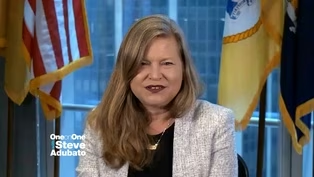
NewExecutive Director of Port Authority talks public transit
Video has Closed Captions
Clip: S2026 Ep2938 | 8m 24s | Executive Director of Port Authority talks public transit (8m 24s)
 New
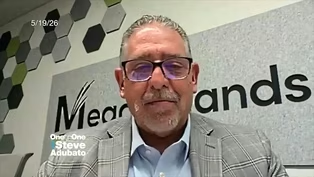
NewJim Kirkos discusses opportunities & the 2026 FIFA World Cup
Video has Closed Captions
Clip: S2026 Ep2938 | 8m 59s | Jim Kirkos discusses opportunities & the 2026 FIFA World Cup (8m 59s)
Providing Support for PBS.org
Learn Moreabout PBS online sponsorship New Episode
- News and Public Affairs

Top journalists deliver compelling original analysis of the hour's headlines.

- News and Public Affairs

FRONTLINE is investigative journalism that questions, explains and changes our world.
 New Episode
 New Episode
 New Episode



 New Episode
 New Episode
 New Episode

Support for PBS provided by:
One-on-One is a local public television program presented by NJ PBS