One-on-One
Ian O’Connor; Saranne Rothberg
Season 2026 Episode 2917 | 27m 39sVideo has Closed Captions
Ian O’Connor; Saranne Rothberg
Ian O’Connor, Columnist for The Athletic and author of "Out of the Darkness," discusses the public perception of Aaron Rodgers and recent leadership changes in the NY Giants organization. Saranne Rothberg, Early-Stage IV Cancer Survivor, CEO of ComedyCures, and Host of the Beating Cancer Daily podcast, explores how laughter can meaningfully support those living with cancer.
Problems playing video? | Closed Captioning Feedback
Problems playing video? | Closed Captioning Feedback
One-on-One is a local public television program presented by NJ PBS
One-on-One
Ian O’Connor; Saranne Rothberg
Season 2026 Episode 2917 | 27m 39sVideo has Closed Captions
Ian O’Connor, Columnist for The Athletic and author of "Out of the Darkness," discusses the public perception of Aaron Rodgers and recent leadership changes in the NY Giants organization. Saranne Rothberg, Early-Stage IV Cancer Survivor, CEO of ComedyCures, and Host of the Beating Cancer Daily podcast, explores how laughter can meaningfully support those living with cancer.
Problems playing video? | Closed Captioning Feedback
How to Watch One-on-One
One-on-One is available to stream on pbs.org and the free PBS App, available on iPhone, Apple TV, Android TV, Android smartphones, Amazon Fire TV, Amazon Fire Tablet, Roku, Samsung Smart TV, and Vizio.
Providing Support for PBS.org
Learn Moreabout PBS online sponsorship- [Narrator] Funding for this edition of One-On-One with Steve Adubato has been provided by The Russell Berrie Foundation.
Making a difference.
Hackensack Meridian Health.
Keep getting better.
The Port Authority of New York and New Jersey.
Moving the region through air, land, rail, and sea.
The Adubado Center for Media Leadership.
Because media matters more than ever.
The New Jersey Education Association.
New Jersey Institute of Technology.
NJIT makes industry ready professionals in all STEM fields.
PSEG Foundation.
The North Ward Center.
And by Horizon Blue Cross Blue Shield of New Jersey.
Promotional support provided by NJ.Com.
Keeping communities informed and connected.
And by Meadowlands Media.
A print and digital business news network.
- This is One-On-One.
- I'm an equal American just like you are.
- The way we change Presidents in this country is by voting.
- A quartet is already a jawn, it’s just The New Jawn.
- January 6th was not some sort of violent, crazy outlier.
- I don't care how good you are or how good you think you are, there is always something to learn.
- I mean what other country sends comedians over to embedded military to make them feel better.
- People call me 'cause they feel nobody's paying attention.
_ It’s not all about memorizing and getting information, it’s what you do with that information.
- (slowly) Start talking right now.
- That's a good question, high five.
(upbeat music) - Hi, everyone.
Steve Adubato.
We kick off the program, part of our "Media Matters" series, produced in cooperation with our Center on Media Leadership with Ian O'Connor.
Talk about a sports media leader.
Ian O'Connor is the author of the book, "Out of the Darkness: The Mystery of Aaron Rodgers," also a columnist for The Athletic.
Ian, it's great to have you with us again.
- Good to be here with Steve, as always.
- This book, why is it important?
And why is he important?
- Well, he's one of the greatest quarterbacks of all time.
I'd put him fifth on the list of all time players at a position that's the most important position in American team sports.
And he was arguably, no, not arguably, he was, and is, the most polarizing player of his generation.
His views on the vaccine and conspiracy theories, and combine that with very candid public speaker, a fearless public speaker, is not afraid to anger the masses with his views.
And is a guy who threw the football probably better than anyone has ever thrown it.
And that doesn't mean he was as great as Tom Brady, who won seven championships, to Aaron Rodgers' one, with the Packers.
But as far as actually the skill set it requires to be a great quarterback, I would say Rodgers and Patrick Mahomes are the two at the top of that list.
And so, yeah, I always found him to be a compelling, mysterious figure, and wanted to take on this project and sort of write the definitive story of his life and career, and hopefully I pulled that off.
- When he was with the Jets and things went wrong, there were times I noticed he would blame other players.
I saw him post-game press conferences, point out other players who didn't do what they were supposed to do.
I'm not a fan of that.
I'm a leadership coach.
Make mistakes all the time as a leader.
But you don't blame your people on your team in public.
Whatever you do privately, different story.
Am I wrong?
Did he point out players?
A and B?
What would be the reason he would do that as the leader, captain, with a C, and a quarterback of the team?
- And you could argue, it's wrong, it's certainly a very valid opinion.
I would say it's the majority opinion.
But I will say this.
When you ask a quarterback the question, what happened on that throw that was intercepted?
And the truth is that the receiver ran the wrong route, you could say, well, listen, as a journalist, I want the truth.
I don't want a fake answer where you're covering for a teammate, which a lot of guys give.
And so he's going to give you the truth, the way he sees it, anyway.
And so and so, Garrett Wilson, whoever it was, ran the wrong route.
- It was.
- In that case then, the one interception he threw that he blamed another receiver, but it doesn't matter.
I think when you ask a question, you want a truthful answer.
And so you could argue that he should give an honest answer.
Now, he did that in Green Bay a few times, and angered some teammates there as well.
But I will point out, which is surprising to a lot of football fans, that the vast majority of his teammates really like him, and like playing with him.
And I had someone in the NFL who'd been in the league for a long time, decades, who knows hundreds upon hundreds of players who hates Aaron Rodgers.
And he told me, "Despite my personal feelings, what I will say to you is, I have never met a player who doesn't like him."
Now, there are a few out there, maybe more than a few, but being around the Jets, they revered him, particularly year one when he came in before the injury.
And I know interviewing dozens and dozens of Packers, they had the same feelings about him.
Now you'll have a few that have the opposite view, and express that publicly, but he is going to give you a truthful answer.
And there are people who believe he does it the wrong way, like you do.
That's a very valid opinion.
But when I'm a reporter, and I ask a question, "What happened on that play?"
I don't want you covering for somebody.
I want you to tell me what honestly happened.
- Ian, it's not my job to express my point of view here, but I'll say this.
As a student of leadership, as a coach of leadership, and that's what it means to be a quarterback.
I don't care whether you're a quarterback of a football team or a media organization, whatever.
See, you call it a candid answer.
I say, someone asked me who screwed up on a chyron on the air, the graphic.
Who screwed up with the audio?
Why did such and such go wrong?
I don't think it's the place that a leader to be candid and tell whomever asked, who did it.
'Cause the truth is, I'm a big believer, and you own it publicly.
Aaron Rodgers sees it differently.
I respect your point of view, but let me ask you this, by the way, the book, "Out of the Darkness: The Mystery of Aaron Rodgers," check it out.
I'm wanna shift gears.
This, as I said, is part of a series we're doing on "Media Matters."
We're talking to sports media journalists like yourself.
Check out our website at a new center called the Abubato Center for Media Leadership, talking to people in media about why it matters.
Question, how much has sports media changed in just the last five years?
- Just, the social media has just changed it so much.
I mean, I can't even recognize the industry I'm in right now compared to the one I entered in the 1980s, but it's just, the one thing that is a little sad, I guess, if you're a sports journalist, is that the athlete now has the opportunity to speak directly to the fan base, and cut out the middleman or middlewoman, just via social media.
And I think there is a distance now between athletes and sports journalists that wasn't there in the past.
And I think that the pursuit of doing really human stories is a little more difficult now because of that.
And because athletes today, superstars, they really feel like they're under 24/7 surveillance with social media, with everyone having a camera in their hands.
And it's just, it's created a gap there.
So if you're a really good sports journalist who cares, and really works at the craft, you try to do everything possible to bridge that gap.
And that's what I try to do.
And you need to show some humanity in your work, I think to successfully get there.
And hopefully I've done that.
But I would say just social media and athletes today, feeling like they're constantly being watched, under surveillance.
If you say something anywhere, it's going to be on camera.
And that does create a little distrust in the process that you have to overcome - Real quick.
The Athletic, part of the New York Times family, media family.
And by the way, go on The Athletic website, check out Ian's work.
I'm curious about this.
The biographies you have written, other than on Danny Hurley, check out our interview, our full program, with Ian O'Connor about his book, "Never Stop."
It's all about Danny Hurley.
This book he wrote about Aaron Rodgers, but you also wrote about Jeter.
I love that book.
You wrote about Derek Jeter.
Any other biographies?
- [Ian] We have Coach K at Duke.
- [Steve] Mike Krzyzewski.
- [Ian] Unauthorized.
I did an unauthorized biography of Arnold Palmer and Jack Nicklaus.
That's going back ways and- - [Steve] Yep.
- My book on Belichick was probably the toughest assignment I've ever had in my life.
To do an unauthorized book on Belichick was like doing an unauthorized study of the Kremlin.
It just, it took everything I had, and I think I pulled it off, a definitive profile of who he was, and is, and how he built that empire in New England.
And it was really, really difficult to get information from inside that program.
But I know I pulled it off.
And frankly think I told- - Great book.
- Well, thank you.
Yeah, and that was my Mount Everest, if you will.
- What, and by the way, great, interesting personality with Belichick, leave it at that.
Hey, I'm gonna go to the Giants, I promise.
Unauthorized means what?
- Means you don't have their consent to do it.
- Got it.
- But that doesn't mean they won't cooperate.
I will say one thing about Aaron Rodgers.
At the end of the process, he gave me a two-hour session at his home in Malibu on the ocean to go over the negatives in the book to give him a chance to counter them or put them in context.
And it made it a better book.
- Okay, by the way, also read the book, because the relationship, or the lack of relationship between Aaron Rodgers and his father and his family is worth it just for that.
Hey, New York football, Giants, this is the Post.
I get the Post on the New York Times every day.
I'm the last person who still gets newspapers.
John Harbaugh comes to the New York football Giants.
Why is it a big deal for those of us who are Giants fans, and think he's gonna turn everything around?
Ian, by the way, check out Ian's article in The Athletic on this topic.
The inside story of the Giants, John Harbaugh deal, and the talks that saved it.
What's big deal, Ian?
- In my 40 years of covering sports in New York, it's the biggest hire that Giants have ever made.
It's the first time they've ever hired a coach who had already won a Super Bowl.
He's arguably, and most likely the most accomplished coach they've ever hired.
They've been really bad for 14 years.
And when they hired Tom Coughlin, by the way, they had been in the Super Bowl four years before that.
So to me this is bigger than that.
This is like the Jets hiring Bill Parcells, the Knicks hiring Pat Riley.
It's really, really big.
They needed a CEO with credibility who would walk into a locker room, and command immediate respect.
And with his track record as a Super Bowl champ, 180 regular season victories, 13 playoff victories, he brings that credibility on day one.
And so, after four straight failed hires following Coughlin, they absolutely had to get this one right.
And I think they hit a home run.
- Question.
As a Giants fan, when the Giants, and there's, I guess it's the HBO series, "Hard Knocks."
When the Giants did not re-sign Saquon Barkley and he goes to the Philadelphia Eagles, we have a whole bunch of folks watching in Southern New Jersey.
Our executive, our senior producer, Chloe Swift is a Eagles fan.
A bunch of others are too.
Don't ask me why.
But he goes to the Eagles.
So now you've got this guy, Jackson Dart, 22, 23 years old?
Who's the quarterback of the Giants, who's supposed to be the savior.
Doesn't have Saquon Barkley, one of the greatest running backs in modern times.
What are the Giants' chances of winning with a quarterback?
That quarterback?
A great quarterback, without the rest of the team?
- It's a very good question.
He's not a great quarterback yet.
He figures to be one someday.
- Potential.
- Potential.
Yeah, right.
But I know that I was on the phone with John Harbaugh a half hour after he agreed to his deal with the Giants that Saturday.
And he told me he expects to be in the playoffs next year.
And I was like, "Well, you do realize they were four and 13 last year, right?"
Yeah, so he said, "No, I looked at the tape, I studied Jackson Dart, the quarterback, some other pieces on the roster.
I liked the talent I see."
Didn't really have a great explanation as to why they were four and 13, but thinks they're good enough with the returning injured players like Nabers and Skattebo to go to the playoffs.
And listen, Giants fans needed to hear that.
They've been terrible for so long.
They needed a coach to come in on the record and say those words, and he did that.
So John Harbaugh, at age 63, Super Bowl champ, is not shying away from anything about the NFC East, or anything else next year.
I think he's looking at trying to go 10 and seven, and at least be a wild card in the playoffs.
I think he's got a realistic chance to pull that off.
- Last question, what's the deal between the Giants fans up in here in northern New Jersey and New York and the, I was gonna say Phillies, the Eagles fans in Philly?
Why do we not like each other?
- Well right now, the Giants fans have a lot more to complain about because the Eagles have been dominant, and the Giants have been the opposite of dominant for years.
It's a little bit like the Red Sox and Yankee fan rivalry back in the day.
And yeah, right now the Eagles have the upper hand.
Their fan base is very, very, very passionate, like New Yorkers are.
And I think seeing the Giants and Eagles in a playoff game where the teams are relatively evenly matched, which hasn't happened.
The last time they played in the playoffs, the Eagles blew out Daboll's first team.
But I think that would be an unbelievable environment.
- Be awesome.
- Yeah.
So let's hope that Harbaugh can get the Giants to that point.
And if that happened next year or the year after that, you'd have a hell of an environment for a post-season game.
- Follow Ian O'Connor and The Athletic.
It's connected to the New York Times, that little newspaper over in New York.
Ian, you are terrific.
We cannot thank you enough.
Also, check out Ian's interview we did about his book, "Never Stop," about Danny Hurley.
He's a great sports journalist, and that's why sports media matters.
Thank you, Ian, all the best.
- You're the best, Steve.
Thank you, take care.
- You got it, stay with us.
We'll be right back.
- [Narrator] To watch more One on One with Steve Adubato find us online and follow us on Social media.
- Hi, I am Jacqui Tricarico, Senior Correspondent for "One-on-One," and so pleased to be joined now by Saranne Rothberg, who is the CEO and founder of the Comedy Cures Foundation, as well as the host of the daily podcast "Beating Cancer Daily."
So great to have you with us, Saranne.
- Thank you.
I'm so glad to be here.
It means I'm still alive.
- And you usually get to speak with Steve, but you get to speak with me today.
We've had you on the program in the past, but we initially were introduced to you and your foundation through the Russell Berrie Foundation and the Russ Berrie Making a Difference Awards.
You won that award back in 2003, but I wanna take it back just a little bit further before that, in 1993.
Tell us about that time in your life and when you were first diagnosed with stage four cancer.
- Well, my symptoms really started to appear in 1993, just after I gave birth to my daughter.
And I went to 11 doctors, 11 doctors, and I kept saying, "Do you think that I have breast cancer because this duct is not draining?"
And my grandmother died of complications from breast cancer very young, but technology was very different then.
They also didn't look at young women with breast cancer the way they do now.
And so I probably would've been diagnosed very quickly in this era, but then it was just ignored for six years.
- Wow, six years.
So then finally in 1999, you do get the diagnosis.
Talk about that time in your life and where laughter and humor really played such a key role in your journey through this cancer diagnosis and treatment.
- Well, I threw a chemo comedy party, and most people don't do that when they're going through their first chemo treatment, but comedy was such a part of my family culture.
I was raised by a single dad and he took me to see comedians very young.
He didn't have to get a babysitter, and we just loved to laugh.
So I couldn't think of a better way to go through something so stressful.
And it was when all this research was coming out on psycho-neuro-immunology, the mind-body connection.
And so I thought, you know, if I can't laugh myself, well, my daughter will have a great time and great memories of her mom if I were to pass, and you know what?
I could bring a lot of joy along the way.
And I used to scout the comedians for Dick Clark Productions.
And so I just had an entire Rolodex at the time, now database, but of comedians.
And so I thought, what a fun way to go through cancer treatment.
Have my friends who were comedians follow me through.
But it was the reaction not only of the patients and the caregivers, but of the staff who's under so much stress and so much pressure, treating very ill cancer patients, that that day I said, "That's it."
I went home and I started ComedyCures.org, the Comedy Cures Foundation.
And they did not think that I was gonna survive three surgeries, 44 radiation treatments, two and a half years of chemotherapy.
- Chemo every day.
- I had chemo three times a day at one point, and yet I just had this incredibly strong mindset.
And even though I kept getting bad news, it was all that reinforcement of the laughter and the positive thinking and the optimism that got me through the toughest days.
And my daughter had a blast because our house was so full of joy and laughter.
- And the evolution of the foundation.
It really has taken off in so many different ways.
What are some of the programs and initiatives that you're most proud of, especially for, of course, cancer patients, but caregivers too?
- Yeah, and hospital staff.
And that was something that was really rewarding.
So during COVID, I started to get calls to do programs for medical personnel because they were under so much pressure and working such long hours.
And then the minute COVID was over, I started to do programs for nurses and hospitals just to kind of reinforce the mental health of the staff.
But my favorite programs are when we integrate the patient, the caregiver, and the medical caregiver, because they go through this together.
Whatever your health challenges or your trauma, it's a team sport really.
And so if I can help everyone start laughing together, they get in sync, right?
Because laughter's breath.
So if everybody starts laughing together, things align and relationships build, and healthcare becomes much more than transactional.
And it's where we are right now.
You only get to see your doctor for a few minutes.
And back in the old days, you used to sit with that local doctor and laugh and they would know about your kids.
And we don't have time now, so that I can help people find the funny in healthcare, and heal, and have humor, and improve health.
It's just the best job ever.
- Well, how are you doing just that?
Give us an example of how you're integrating everyone and creating that environment for people to laugh.
Give us an example of that.
- So one of our signature programs that has gotten the most attention, I think, is Laughing Lunch.
And Laughing Lunch is where a patient can invite three other people or a caregiver, a medical person can invite... So a medical person can invite up to 10, like an entire support group or a bunch of patients and caregivers.
And they come in, we spoil you, feed you, and the program is free.
And then as the people start chatting and talking, they forget that they're really in a medical setting because it's like going out to a comedy club that caters.
And then the show starts, and people think they're coming there just to laugh.
But it's actually a community-building opportunity where we teach about psycho-neuro-immunology, the mind-body connection, and the science behind why laughter and a comic perspective is so good for you, and creating resiliency, positivity, and wellness.
And we know looking at chemo studies that if someone is positive and happier and more emotionally uplifted, the chemo is actually responded to better.
So it's not just to feel good; it's to have strategies for coping.
One of the programs I love is that I got to produce the first program of this kind at the United Nations, at the World Health Organization in Geneva, and for the families reuniting after September 11th.
So that program on Broadway with Rotary International, the 9/11 Fund, was just a historic moment for me because my dad was a trader downtown.
And so the fact that I got to live with my dad after that, because he didn't go to work that morning, I really felt connected to those kids and those families.
He was in the '93 bombing.
So this has taken me way beyond the chemo room, and now that I get to do research studies, it's incredible.
- Talk about how you're taking all of that and what you've learned, and you're bringing it into this daily podcast, the "Beating Cancer Daily" podcast.
What does it mean to you to share so much information and stories on that podcast for your listeners every day?
- Well, I found out today that we are now in 142 countries.
We are on all seven continents.
And this podcast wasn't originally designed for the public.
It was like a love letter back to the participants in my two research studies, which involve stage three and stage four cancer patients.
And the first study is actually published now because it was so groundbreaking.
And I wrote the first AI study in cancer survivorship.
And the second study, they called a new protocol in cancer care.
So when that was over, the patients were like, "You cannot stop teaching us."
Not one patient was re-hospitalized with stage four cancer in my second study.
And that's groundbreaking for families, for the patient, and also for the burden on our healthcare system.
So the patients just said, "You have to keep teaching us."
They came up with the idea of a podcast, but they said they wanted it daily.
How do you even do that, right?
But you want it done, you give it to a stage four cancer survivor.
So a cancer survivor paid for this microphone and paid for an editor, and I got going, and I am over 400 daily episodes later.
- Incredible.
- And I thought I was done at 365 because that was the commitment to the patients, but now they don't want it to stop, and now they want it to go to video.
So we have to raise more money because I can do podcasting in my pajamas at two o'clock in the morning, but I kinda have to look like this to do videos.
- The video aspect, yeah.
- So I hope people wanna support it and I can support their loved ones.
You know, Jacqui, the thing that I find so incredible is that it just went word of mouth.
Patients shared it, nurses shared it, caregivers shared it, and somehow we got even to Antarctica.
Doctors signed a flag telling me they were the first listeners in Antarctica.
So it's really beyond my wildest dreams.
- Well, congratulations on the podcast, and I know our viewers can take a listen with the website that's been up for Comedy Cures Foundation as well.
And it links out to the podcast, such great, useful information on there.
And we can't wait to see what else happens with you and the foundation and the podcast.
Congratulations, and thank you so much for joining us, Saranne.
- Thank you.
Tell everybody, pray that we win the best health series of the year; we're nominated.
- That's wonderful.
Congratulations.
We will, we will.
Thank you so much.
We really appreciate your time.
For Steve Adubato and myself, thanks for watching.
We'll see you next time.
- [Narrator] One-On-One with Steve Adubato is a production of the Caucus Educational Corporation.
Funding has been provided by The Russell Berrie Foundation.
Hackensack Meridian Health.
The Port Authority of New York and New Jersey.
The Adubado Center for Media Leadership.
The New Jersey Education Association.
New Jersey Institute of Technology.
PSEG Foundation.
The North Ward Center.
And by Horizon Blue Cross Blue Shield of New Jersey.
Promotional support provided by NJ.Com.
And by Meadowlands Media.
- (Narrator) Public service.
It's what we do, at the PSEG Foundation Through volunteer hours, partnerships and our other contributions.
We're committed to empowering communities.
We work hand in hand with you, our neighbors, to educate young people, support research, environmental sustainability and equitable opportunities, provide training and other services all over New Jersey and Long Island.
Uplifting communities.
That's what drives us.
The PSEG Foundation.
 New
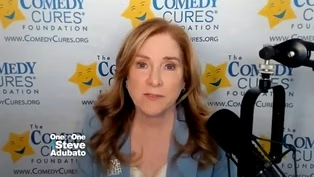
NewHow laughter can support those living with cancer
Video has Closed Captions
Clip: S2026 Ep2917 | 12m 34s | How laughter can support those living with cancer (12m 34s)
 New
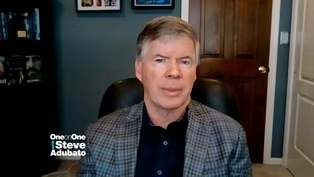
NewIan O’Connor talks the public perception of Aaron Rodgers
Video has Closed Captions
Clip: S2026 Ep2917 | 14m 25s | Ian O’Connor talks the public perception of Aaron Rodgers (14m 25s)
Providing Support for PBS.org
Learn Moreabout PBS online sponsorship
- News and Public Affairs

Top journalists deliver compelling original analysis of the hour's headlines.

- News and Public Affairs

FRONTLINE is investigative journalism that questions, explains and changes our world.












Support for PBS provided by:
One-on-One is a local public television program presented by NJ PBS