One-on-One
Naomi Gewirtz; Calvin R. Ledford Jr.; Jack Ford
Season 2026 Episode 2919 | 27m 47sVideo has Closed Captions
Naomi Gewirtz; Calvin R. Ledford Jr.; Jack Ford
Naomi Gewirtz, President & CEO of the Adler Aphasia Center, discusses awareness for aphasia and their committed to training future clinicians. Calvin Ledford, Jr., President of PSEG Foundation, discusses the impact corporate responsibility initiatives have on small businesses. Jack Ford, Author, Legal Analyst, and Emmy Award-winning Journalist, examines challenges in today’s media landscape.
Problems playing video? | Closed Captioning Feedback
Problems playing video? | Closed Captioning Feedback
One-on-One is a local public television program presented by NJ PBS
One-on-One
Naomi Gewirtz; Calvin R. Ledford Jr.; Jack Ford
Season 2026 Episode 2919 | 27m 47sVideo has Closed Captions
Naomi Gewirtz, President & CEO of the Adler Aphasia Center, discusses awareness for aphasia and their committed to training future clinicians. Calvin Ledford, Jr., President of PSEG Foundation, discusses the impact corporate responsibility initiatives have on small businesses. Jack Ford, Author, Legal Analyst, and Emmy Award-winning Journalist, examines challenges in today’s media landscape.
Problems playing video? | Closed Captioning Feedback
How to Watch One-on-One
One-on-One is available to stream on pbs.org and the free PBS App, available on iPhone, Apple TV, Android TV, Android smartphones, Amazon Fire TV, Amazon Fire Tablet, Roku, Samsung Smart TV, LG TV, and Vizio.
Providing Support for PBS.org
Learn Moreabout PBS online sponsorship- [Narrator] Funding for this edition of One-On-One with Steve Adubato has been provided by The Russell Berrie Foundation.
Making a difference.
Horizon Blue Cross Blue Shield of New Jersey.
Hackensack Meridian Health.
Keep getting better.
Valley Bank.
Stockton University.
The North Ward Center.
The Adubado Center for Media Leadership.
Because media matters more than ever.
South Jersey Industries.
The parent company of South Jersey Gas, and Elizabethtown gas.
And by EJI, Excellence in Medicine Awards.
A New Jersey health foundation program.
Promotional support provided by NJ.Com.
Keeping communities informed and connected.
And by BestofNJ.com.
All New Jersey in one place.
- This is One-On-One.
- I'm an equal American just like you are.
- The way we change Presidents in this country is by voting.
- A quartet is already a jawn, it’s just The New Jawn.
- January 6th was not some sort of violent, crazy outlier.
- I don't care how good you are or how good you think you are, there is always something to learn.
- I mean what other country sends comedians over to embedded military to make them feel better.
- People call me 'cause they feel nobody's paying attention.
_ It’s not all about memorizing and getting information, it’s what you do with that information.
- (slowly) Start talking right now.
- That's a good question, high five.
(upbeat music) - Hi, everyone.
Steve Adubato.
We kick off the program with our longtime friend, Naomi Gewirtz, who is the President and CEO of the Adler Aphasia Center.
Part of our series Voices of Aphasia, we're doing in cooperation with the center.
Good to see, Naomi.
- Good to see you too.
Thanks for having me.
- Listen, I never wanna assume people know, that people know exactly what aphasia is.
Some of us have family members, you included, impacted by aphasia, but for those who may not know, please let them know, Naomi.
- Sure.
So many people don't know what the word aphasia means.
Ultimately, when we talk about aphasia, it's loss of language, not intellect.
And so after stroke or brain injury, the language center of the brain can be impacted.
And so when someone is trying to get their words out, they have often a hard time finding those words.
And so they know what they want to say, but they can't find the words.
And so at the Aphasia Center, we work with our members to help them with their communication, introduce new ways to communicate and build community.
- You have a personal connection to aphasia- - I do.
- With your dad.
Please.
- Yeah, so like many, I did not know the word aphasia.
And shortly after working at our center, my dad personally was impacted, had a stroke, then had aphasia as a result of it.
And so everything that I heard about and learned and saw firsthand at the center, I was then experiencing as a caregiver myself.
- Yeah.
You know, I only know about aphasia because of two people, Mike and Elaine Adler.
They started the center.
They brought me in and a bunch of other folks to try to be helpful and be engaged in public awareness.
That's what we've been doing.
I've been honored to host the annual gala of the Adler Aphasia Center for years.
Go on... Jacqui Tricarico, our Executive Producer of Remember Them, and I did a special on Mike and Elaine.
Go on our website, check that out.
Mike, you know, Mike experienced aphasia.
Elaine cared for him and became such an advocate.
Why, for those did not know Mike and Elaine, why are they so incredibly important in the fight to create greater public awareness around aphasia?
Please, Naomi.
- Yeah, so Mike and Elaine, you know, they created a voice and a platform for people to learn about aphasia in New Jersey and nationally.
And New Jersey what they did was not only create a space for advocacy and awareness and education, which is part of our mission, they very much created a space for people to come to.
People who have aphasia, often after stroke or brain injury, are in a rehab facility after leaving a hospital.
They do outpatient rehab.
And for many after that, they are home.
There is no place for them to go.
And so the center is really where Mike and Elaine saw a place for people to find a home, find people who are like them not be alone in this journey, because for so many, including someone like Mike, what they experienced was that you can go through sort of the normal experience of the hospital and the rehab and so on, but then what is there for you, which is really the impetus for them creating the center and really a community, something that doesn't feel medical, but a place that people desire to go to following these experiences.
- I'm curious about the Adler, excuse me, the Aphasia Communication Groups.
And you're also doing it in cooperation with some of our higher ed partners down at Stockton University as well.
You partner with all kinds of folks.
What are these Adler, excuse me, these aphasia... I can't say aphasia without the Adler name.
That's what it is.
The Aphasia Communication Groups.
Please talk about it.
- Sure, so the Aphasia Communication Groups, it's a part of our programming.
And so all of our programming in a sense is groups for people who have aphasia, while also, of course, serving caregivers and the general community.
But for people who have aphasia, many do want to come to our centers and have a way to get here, whether it be through community transportation, transportation they can provide themselves.
Some aren't able to participate in groups for hours at a time or simply just have barriers that don't allow them to come to a center, such as the one that we have in Maywood, Toms River, or in West Orange.
And so the Aphasia Communication Groups are smaller groups that meet throughout the state.
We have many that are in person and also online virtually.
And so these are groups that meet twice a month for two hours at a time.
For some people, it is their choosing to do something like this closer to home.
Some people, the virtual option is best, but ultimately what it still creates, which is similar to what we're doing in person at our centers, is community, communication, seeing people who look and sound like you, and so that you don't feel alone.
- You know, I know that the Adler Aphasia Center is very committed to helping medical students, nursing students, those who become physicians and nurses understand more about aphasia, how to treat more effectively patients dealing with aphasia and family members.
Talk about that initiative.
- Sure.
So one of the things that we do that we're really very proud of is we bring in medical students, nursing students, as you said, and they meet with our members.
They learn from our members firsthand.
They hear about the experience that those, then patients, now our members, had in the medical setting to better understand and learn what that experience was, could be, should be.
And so we're teaching these future professionals that are in medical settings so that it's not just a learning experience.
They're taking it back in real-time to the settings that they're in and in the future, and of course, in the future, wanting them to refer patients to us so they have a home away from home after stroke and brain injury.
- Aphasia does not discriminate, does it?
- Does not.
- Anyone?
- Anyone.
We have members here that are in their 20s, we have members here that are in their 90s, people from all backgrounds, all around the state, all sorts of professions, it does not discriminate.
But I think the thing that's really special about our center is that we have members here that can say a syllable, we have members here that can say sentences, and their aphasia isn't all that detectable.
The patience and understanding that our members have for each other is remarkable.
And so well, no, aphasia does not discriminate.
This is a place of acceptance and love and happiness.
There's so much laughter and joy here.
It's really a very special place around the state.
- To Naomi's point, every time I've been honored to host that gala, the Adler Aphasia Gala, I meet new people dealing with aphasia, their family members.
We've had many on our programming, which is why you should go on our website, SteveAdubato.org, and check out previous interviews.
These people are, their voices matter, their voices are powerful and impactful and inspiring to so many.
And the work of the Adler Aphasia Center is a key part of that.
And to Mike and Elaine who are no longer with us, but their spirit lives on, their work lives on, the team that they built continues to do what they're doing, I say thank you.
We look forward to continuing to partner with the Adler Aphasia Center and creating more public awareness.
And by the way, Bruce Willis, one of the most famous people in the world, is dealing with aphasia.
He's just one of many, and they're not all famous, but they're all fighting to find their voice in challenging times.
Naomi, I wanna thank you so much for joining us.
We appreciate it.
- Thank you, Steve.
- You got it.
Stay with us, we'll be right back.
- [Narrator] To watch more One on One with Steve Adubato find us online and follow us on Social media.
- We are honored to be joined by Calvin R. Ledford Jr., President, PSEG Foundation, Director of Corporate Social Responsibility at PSEG, one of our longtime underwriters.
Good to see you, Calvin.
- You as well.
Good to see you.
Happy to be here and thanks for having me.
- Always, and you've been a great partner for many years.
Question, I've been asking people about their leadership journey to be where they are right now.
Identify one, possibly two key mentors in your life that have helped you become the corporate philanthropic leader you are today, Calvin.
- So if I go back early in my career, unfortunately he's no longer with us, but he was a manager at PSEG.
A gentleman by the name of Jerry Valvano, who was a manager in the billing organization.
And when I was a bargaining unit employee at PSEG, we took to one another as a mentor-mentee relationship.
And he provided a lot of guidance over the years.
And so I'm very thankful to some of the early lessons that he taught.
And I have to be honest with you, in recent years, it's been Rick Thigpen.
- Rick, our good friend Rick.
How so?
How so, Calvin?
- So when I first came out of operations and started working for Rick back in 2013, although I had done a stint on the Newark School Board and the planning board, Rick was able to introduce me to the larger political game of our cities, counties in the state.
And coming from operations, I had much more of a PSEG-driven focus and trying to accomplish the needs of the business.
And Rick helped me to learn very earlier in coming into governmental affairs, how that needed to be balanced with the needs of the community, the needs of elected officials.
And between those two, I'm very thankful.
- And you continue to be a mentor to others today.
- Absolutely.
You know, you pass it on, pass it on.
So whether it's through coming and speaking to youth in groups, there's times I get reached out to and find out about a young man or a young lady who is struggling with a personal issue and I get asked to partner with them.
And I'm always available to do that.
And I look forward to continuing to do that.
It's about passing on the skills to the future leaders.
- The other side of that is interesting because the PSEG Foundation, and by the way, the website will be up right now, look up the foundation, look up who they've provided grants to, not-for-profits, organizations like ours, others.
I'm curious about the question of nonprofit leadership.
And you and I have talked about this offline as well.
When you and your team have to make very tough decisions, what kind of 'leadership' in the not-for-profit community are you looking for?
I may put it a different way.
What are the top two or three leadership tools a nonprofit leader or leadership and organization has to be in place in order for you to write, you and your team to write a big check because they're spending that foundation money?
Please, Calvin.
- Well, so it starts with does that organization, does that leader, is the mission of that organization aligned with the pillars of the foundation?
I mean, you know yourself, right?
We're not in a position to fund everybody just because they happen to be a nonprofit, right?
So our pillars are environmental sustainability, social justice and equity and economic empowerment.
So alignment is first.
The second major decision is driven by past performance with regards to impact.
Are you having an impact in the communities that you serve?
Do other nonprofits, do community leaders, do leaders in the municipality or county see your nonprofit organization as one of the pillars of the community because of the impact that you have and what's your mission?
And those are the two key drivers.
- What about the fiscal stuff, the bottom line, the money stuff, how they manage their money?
- So that's a part of the impact, right?
Part of our process is twice a year, we look for impact reports.
So the impact reports are not just about who you served and the response to you serving them.
It's also did you use the resources in the way that you told us that you would?
Show that to us.
Let it see that.
Are you an organization that if you learn during the course of your mission for that year, you really didn't need as much money as you asked for and we may have provided to you?
Do you come back and say, "We have extra resources.
"Is it okay to reallocate or repurpose those resources "or PSEG Foundation, would you like those resources back?"
Those are key drivers.
- Last question on this.
Your greatest satisfaction, 'cause you've been in different roles as a leader, and now in the philanthropic world, the corporate philanthropic world, what is the most significant positive benefit that you get?
Meaning the greatest satisfaction you get from the work you do every day with your colleagues at the foundation?
- It starts out as a partnership behind a mutually beneficial concept.
When a nonprofit has a mission that aligns with our pillars, but also aligns with something very important to PSEG as an enterprise.
I've just shared with you, environmental sustainability is one of our key pillars.
Equity and economic empowerment, right?
But I can't very well speak to an individual who may not be gainfully employed, who may be going through a period of time of food insecurity, about purchasing some newer appliances that will help you save and reduce the amount of energy.
- That's right.
- That's not your focus right now.
So for us, if you're an organization that's into workforce development and we're able to fund you, and that leads to some impact and outcomes where you've increased the viability of some families' lives, they're now positioned to be open to a conversation about environmental sustainability and using less energy, which we all know is better for our world.
So when there's a mutually beneficial strategy and the outcomes align.
- Well said, Calvin Ledford Jr.
President, PSEG Foundation, Director of Corporate and Social Responsibility.
Calvin, thank you.
Not just for this interview, but the support that you and your colleagues at the foundation provide to not-for-profits like ours and so many others tied to the pillars that you described.
Thank you, Calvin.
- Thank you for having me, Steve.
- Always.
Stay with us, we'll be right back.
- [Narrator] To watch more One on One with Steve Adubato find us online and follow us on Social media.
- Hi, everyone.
Steve Adubato.
We welcome our good friend, Jack Ford, who is an author, a legal analyst, an Emmy Award-winning journalist, a longtime colleague in public broadcasting.
He's the author of this book, "Beyond This Place of Wrath and Tears."
We're doing a separate interview with Jack, an in-depth interview about this book.
But this segment is part of a series we're calling Media Matters.
Check out our website, a whole range of programs under the banner of Media Matters, and produced in cooperation with the newly established Adubato Center for Media Leadership.
Hey, Jack, we're honored to have you be that first interview.
We're also interviewing our mutual friend and colleague, Neil Shapiro president of WNET group right after this, part of Media Matters.
Why does media matter, independent media and journalism matter now in 2026 more than ever, ever, my good friend, Jack Ford?
- You know, our history, Steve, as you know... Yeah, let's go back to when we were colonies.
All right?
And the history was Benjamin Franklin starts a newspaper.
You had various other colonies and cities, they were really just big towns at the time.
And what they realized was that they couldn't just get their news shipped across the ocean to them from Great Britain.
The notion was, look Thomas Jefferson said, "Opinion is power.
Knowledge is power."
And from back in those colonial times, we realized we needed to know what's going on around us so that we could make intelligent choices and decisions.
And in that era, obviously, those choices and decisions were dramatic.
And what we've seen over the course of time, and this is interesting, and you understand this, you and I have had these conversations.
Sometimes people will look and they'll say, "Oh, yeah, media has become all about opinion.
That's terrible."
It isn't.
It's always included aspects of opinion.
The difference, my belief is, you could understand which was opinion and which was the general true genuine journalism.
And one fed the other, and that was always fine.
I think why media matters so much now is because we've lost the distinction between opinion, again, very valuable, and reporting, which is gather up the facts, distill them into an understandable package in every way you might do it, radio, podcast, television, online platforms, and then present it to the public.
And the public then has their opportunity to say, "Okay, I get this now.
I understand how this is all working and who's saying what to whom and what's being done, and now I can make my decision, an educated and informed, most importantly, decision about what I think about all of this."
And what's happened now, and Steve, again, you and I go back a long time.
- Yep.
- We've had these conversations before.
There are so many platforms- - And by the way, when you... Sorry for interrupting.
- Yes.
- Jack's been a part of not only NBC and other networks before, but also public broadcasting for many years one of the three anchors, co-anchors on MetroFocus, a program our friend, colleague, and leader, Neil Shapiro, created.
It was not our job when you were one of those co-anchors- - Yes.
- And me in this shop, it is not our job to do commentary, correct?
- Correct.
- Yeah.
- Unless... And again, in our show, it wasn't.
What you do now- - Yeah.
- It isn't.
There are some shows or some people who might say, "Okay, this is now my commentary segment."
But generally, you're absolutely right.
- That's right.
- It was not our job.
And it was our- - Our job is to engage other people.
- Right.
But Jack, here's the thing that the whole reason why this Center for Media Leadership I created, and it's a family foundation.
Full disclosure, you can check it out.
But it's because in all candor, I am concerned, and I know you are because we've had so many conversations on the air and off, about the fact that our media is so bifurcated and chopped up and polarized.
People just go to a website, go to a digital platform, get their algorithm that tells them they already are right about something, so everything there gets reinforcing it.
Those of us in public broadcasting and doing this kind of work, that's not our thing.
- No, it isn't.
And what's- - Is there a place for this anymore, Jack Ford?
- There is.
I think there is.
And I think what we have to do is we have to be very strong about staking out that place.
Here's the situation.
I don't want to call it a problem, but here's the situation.
When I first started to do journalism, television news, in the late 1980s, there were three networks, right?
And there were radio stations and newspapers.
Right?
And it sounds quaint that's where people got their news from.
What we have now is this vast array of platforms, and we've talked of it.
It's podcasts, it's television still- - Right.
- It's radio, it's online.
So there's so many places for you to go to get so-called news- - Including TikTok- - Information, and opinion - Facebook, and X.
- Yes, yes.
- And I'm not sure that's news, but go ahead, Jack.
- Yeah, yeah.
So, the question now for let's call it the media that's looking to provide information as opposed to the media that's looking to proselytize.
And that's fine.
I'm not condemning that.
But what we need to know as a society, as a public, is where do we go to find here's our news, here's the information, and then we can find where do we go to get our opinions from people if we want them?
Where do we go to, to... A lot of people are just, as you've mentioned before, Steve, a lot of people are comfortable just saying, "Tell me what I want to hear, what I believe," as opposed to saying, "You know, let me know everything here, and then I'll figure out what I believe."
- And hold on, Jack.
- So- - Yeah.
- I'm sorry for interrupting- - Sure.
- 'Cause I said I wasn't gonna engage in opinion or commentary, but I need to... With a question, it'll be clear what my thinking is.
What about if we present an interview, Governor Sherrill, just elected in New Jersey.
I'm gonna interview Governor Sherrill.
As an independent journalist, you and I have done it.
Our colleague Raphael Pirelman did it for years.
Just because we're interviewing Mikie Sherrill, the argument is, "This is fake news.
You're an enemy- - Yeah - Of the people."
Why?
Because you're interviewing a Democratic governor.
We've interviewed- - Yeah.
- Republican governors as well.
For people who have already decided that what we're doing is not legitimate, how the heck do we break through?
- Yeah, we've gotta make people understand that everything is not partisan, nor does it need to be partisan, and especially it doesn't need to be viciously, tribally partisan.
You know, here's the thing about a democracy.
Curiously, you know, Thomas Jefferson did not like at all the idea of party politics.
He predicted, and Jefferson had some, a lot of flaws, we know, but he was a brilliant man.
He predicted the introduction of parties, political parties, would create this rank partisanship that could tear at the fabric of democracy, right?
But what we have to make people understand is just because you are interviewing a governor who happens to be a Democrat, you've also interviewed Republicans, it doesn't mean that you share their views about... You know, I was always very careful, and I've seen you do this, too, when I was interviewing somebody, and I wanted to challenge their opinion.
What I found is if I challenged it in a way that made it sound remotely as if it was coming from me, people would say, "Oh, sure, that's what he's saying.
He's over here on the right or on the left," yeah.
So I, you know, what we find we have to do to hopefully get people understand it, and I said I've seen you do this, is I'll say to them, "Here, here, Governor, Senator, Congressperson, here's what your critics say about this.
How do you answer that?"
So you have to try very hard to get people to understand this is not me introducing my opinion.
My greatest compliments I've ever had, Steve, and I'm sure you had, too, is we're finishing a- - They don't know what- - Interview, and I- - They don't know how we vote.
- Exactly.
- There it is.
- And I had a viewer say, "I had no idea what you thought about that."
- That's right.
- And I'd say, "Thank you so much.
You've just made me delighted about the job."
- By the way this whole series, Media Matters, will focus largely on media leaders making a difference, and that top of the list is Jack Ford.
And boss, by the way, the other interview we're doing with Jack is about his book, which is powerful and important, and also about an unknown, for many, media leader who's no longer with us but very impactful.
Hey, my friend, this will be one of many conversations that we have with you as part of our Media Matters series.
Thank you, Jack.
Appreciate it.
- Steve, it's always a delight to spend some time with you.
You take care.
- I'm Steve Adubato.
More importantly, that's Jack Ford.
We'll see you next time - [Narrator] One-On-One with Steve Adubato is a production of the Caucus Educational Corporation.
Funding has been provided by The Russell Berrie Foundation.
Horizon Blue Cross Blue Shield of New Jersey.
Hackensack Meridian Health.
Valley Bank.
Stockton University.
The North Ward Center.
The Adubado Center for Media Leadership.
South Jersey Industries.
And by EJI, Excellence in Medicine Awards.
A New Jersey health foundation program.
Promotional support provided by NJ.Com.
And by BestofNJ.com.
- You are your child's best advocate.
No one cares more about your child's health, safety, development, and wellbeing more than you.
Empower yourself with the vaccination information you need to make the best decisions for your child.
Hackensack Meridian Health can help.
Learn more about fact-based information at hackensackmeridianhealth.org/ vaccine-facts and always talk to your child's pediatrician.
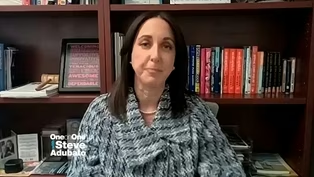 New
NewCEO of Adler Aphasia Center brings awareness to aphasia
Video has Closed Captions
Clip: S2026 Ep2919 | 9m 10s | CEO of Adler Aphasia Center brings awareness to aphasia (9m 10s)
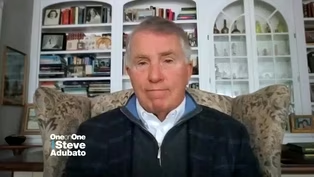 New
NewJack Ford examines challenges in today’s media landscape
Video has Closed Captions
Clip: S2026 Ep2919 | 9m 58s | Author Jack Ford examines challenges in today’s media landscape (9m 58s)
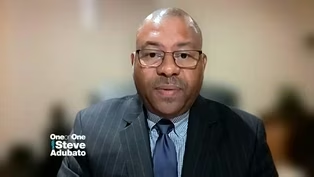 New
NewPSEG Foundation addresses corporate responsibility
Video has Closed Captions
Clip: S2026 Ep2919 | 9m 3s | PSEG Foundation addresses corporate responsibility (9m 3s)
Providing Support for PBS.org
Learn Moreabout PBS online sponsorship
- News and Public Affairs

Top journalists deliver compelling original analysis of the hour's headlines.

- News and Public Affairs

Today's top journalists discuss Washington's current political events and public affairs.











Support for PBS provided by:
One-on-One is a local public television program presented by NJ PBS