State of the Arts
People & Stories
Clip: Season 44 Episode 9 | 8m 39sVideo has Closed Captions
People & Stories / Gente y Cuentos uses literature to foster connection and community.
Founded in 1972, People & Stories / Gente y Cuentos uses literature to foster connection and community across New Jersey. Through oral readings and group discussions in settings such as treatment facilities, senior centers, prisons, and adult education programs from Princeton to Perth Amboy, participants explore new perspectives and experiences through the written word.
Problems playing video? | Closed Captioning Feedback
Problems playing video? | Closed Captioning Feedback
State of the Arts is a local public television program presented by NJ PBS
State of the Arts
People & Stories
Clip: Season 44 Episode 9 | 8m 39sVideo has Closed Captions
Founded in 1972, People & Stories / Gente y Cuentos uses literature to foster connection and community across New Jersey. Through oral readings and group discussions in settings such as treatment facilities, senior centers, prisons, and adult education programs from Princeton to Perth Amboy, participants explore new perspectives and experiences through the written word.
Problems playing video? | Closed Captioning Feedback
Where to Watch State of the Arts
State of the Arts is available to stream on pbs.org and the PBS app.
Providing Support for PBS.org
Learn Moreabout PBS online sponsorshipLeary: "Abalone, Abalone, Abalone.
At noontime, I used to go to his front porch and look at his collection of abalone shells.
I had often seen him sit for hours on Sundays, polishing each one of the shells with the greatest of care."
Why would anyone spend so long doing that?
Participant: Dedication.
Leary: Dedication?
Why else?
Participant: That's his own personal experience.
I think maybe that there's -- there's some type of inner value that this young man starts to see when he's washing off the abalone shells.
I think that that's what the whole point comes down to.
You have to seek out wisdom and the beauty of -- that you find in this world, and you know what?
And take it, grasp it, and hold on to it.
Leary: People & Stories is a program that brings people together from all walks of life, with the goal of helping to improve literacy outcomes, to connect people from many different backgrounds in our shared human experience, and community building.
I think it just really engages some deep part of us.
It's a shared live experience that just exists in that moment together.
Thankfully, this neighbor is kind to him, but like I said, he won't give him all the answers.
And some of you explain, like, he doesn't owe it to him, but does that make him a good teacher or mentor?
Lampert-Rudman: We serve a wide variety of communities -- those who are incarcerated, those experiencing homelessness, those in transitional housing, those in reentry, seniors at senior centers, and public libraries.
The ethos is getting people to bring themselves and look at themselves differently through literature.
Our programs are generally eight weeks.
They receive a story.
It's very nondescript.
All they see is the title and the author's name.
Most of our 300-plus stories in our bibliography are in the public domain.
They listen to the coordinator read this story.
They're usually no more than 10 minutes.
They are line numbered every five lines, so that the coordinator who's reading the story can bring people back to the story for reference.
Leary: But it's in the eye of the beholder, right, that we just came back to.
The top of page 32, the narrator says, "Why, I thought this collecting hobby of abalone shells was a simple affair."
Lampert-Rudman: At the end of the 90-minute session, people now have different opinions, beliefs, ideas about the people that they were in the room with.
Participant: Now, to me, that's what education is.
It's not that formal thing, necessarily.
Participant #2: It doesn't stop.
Participant: She taught me something today.
Luciano: What?
Participant: "Coqui!"
Luciano: Oh, coqui.
Participant: "Coqui!"
Luciano: The Puerto Rican little toad from -- that sings at night.
"Coqui."
Smith: This is the Crossing Borders group.
Working with seniors is different than working with anyone, because they bring all this life experience.
But you get a chance to meet people from different backgrounds.
A lot of times, you don't even realize that people from different backgrounds are exactly like you.
And that's what the people here keep saying.
"I didn't know that you thought that way.
Participant #3: I definitely agree.
As a society, we have to get to the point where we acknowledge that those lived experiences are worth something.
Where you're going to do most of your learning is when you're in the outside world actually in practice.
Luciano: When you're a certain age, and you live alone, and your family's away, this is something to look forward to.
We all come from different backgrounds, and everybody gives their feedback on their perspective, in terms of their culture, their socio economic upbringing.
And that is so wonderful.
He had his business as a shoemaker, and a lot of cultures started that way.
And he wanted a better life with his -- for his daughter because of what he went through.
A lot of men from Puerto Rico came over in the '40s.
Schwartz: We learn a lot about each other.
What's nice is that everybody has a say.
Could be different from you.
And then I would say what really personifies the group is their ability to be flexible and to accept other ideas.
That's an interesting answer.
I would never have dreamed anyone would say that, because for me, it's like a really flagrant description of prejudice.
Lampert-Rudman: People & Stories started in 1972 with our founder, Sarah Hirschman, who was a woman who loved literature.
She loved traveling.
Originally, it was in Spanish.
She looked for stories that are complete in and of themselves, and they leave more questions than answers at the end.
She was inspired by an educator, Paulo Freire, and his belief and her belief was that people learn in all different ways.
Smith: So, what do we think about that?
Is education just books, or can it be other things?
Lampert-Rudman: We don't sit there and say, well, now we're going to discuss the poetics of this story, and now we're going to discuss where the tensions were in this.
It just comes naturally.
Smith: Why does he give him two years?
Why do you think he says wait for two years?
Lampert-Rudman: We're not trying to teach them anything.
We want them to bring themselves to it, bring their own questions to it, and then get what they need from it.
Pygum: At the time I went to school, I never even heard of stories like this.
You don't really know about the story until you talk about it, and you get to hear different opinions.
You never know what you can learn from just talking.
You get to share things that maybe can change people minds about things, the way they go about things.
Leary: Did any of you have a teacher like this who taught you by kind of throwing you in the deep end?
Someone that just -- They weren't going to do it for you, and they didn't use a lot of words.
Pygum: I teach with care.
Leary: What does that mean to you?
Pygum: I just don't want nobody to know things on they own.
Knowledge is free.
Leary: Okay.
Pygum: All that is free.
It's just, some people don't want to give it to you.
Leary: At the end of our eight weeks, they've earned a certificate from the program.
And why that can be important, especially in a place like The Father Center, is, most of these men are trying to find sustainable employment and are doing applications and interviews daily.
And so this is just one more tool for them to include in their portfolio with their résumé.
Saiz: Today was a different day, because we never had a writer.
So it was very special.
She did a great job connecting with the group.
Mendez-Booth: So, I brought a few short pieces.
that are meant to be performed.
I don't usually do my work in Spanish, so it was wonderful to have that participation with the group.
So it became more of a sharing.
Smith: Everybody has a story to tell, and every story resonates some part of your life.
Leary: Literature is our birthright, and everyone should have equal access to it.
I think we are all starved for connection, in-person, human connection.
We all want to be seen, heard, and understood, and this is an amazing format for that.
Really listening and being open minded to someone else's point of view and walking away a little bit different in your convictions than maybe you came in the room would be hugely valuable for all of us.
Saiz: We are all waiting to be heard, to be listened to, and we are all waiting to listen to others, to tell us their own stories.
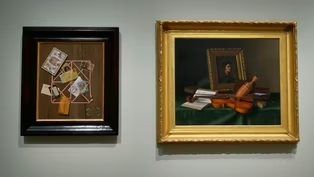
An Artist's Journey from Obscurity to Fame: The John F. Peto Studio Museum
Video has Closed Captions
Clip: S44 Ep9 | 7m 30s | Forgotten in life, John F. Peto's legacy is revived through the restoration of his home. (7m 30s)
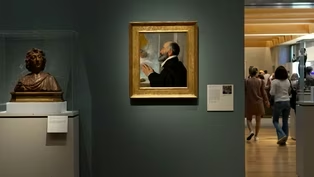
Showing the Work: The Conservation Studios at the Princeton University Art Museum
Video has Closed Captions
Clip: S44 Ep9 | 7m 54s | Princeton University Art Museum opens its conservation studios to the public. (7m 54s)
Providing Support for PBS.org
Learn Moreabout PBS online sponsorship New Episode
- Arts and Music

Innovative musicians from every genre perform live in the longest-running music series.









 New Episode
 New Episode

Support for PBS provided by:
State of the Arts is a local public television program presented by NJ PBS