State of the Arts
Showing the Work: The Conservation Studios at the Princeton University Art Museum
Clip: Season 44 Episode 9 | 7m 54sVideo has Closed Captions
Princeton University Art Museum opens its conservation studios to the public.
The brand new Princeton University Art Museum, was designed to include two active art conservation studios, where conservators Bart Devolder and Elena Torok use state-of-the-art technology and meticulous hands-on work to study, prepare, and restore a variety of works for exhibitions. The conservation studios are now open to the public, showing the usually hidden work that keeps art alive.
Problems playing video? | Closed Captioning Feedback
Problems playing video? | Closed Captioning Feedback
State of the Arts is a local public television program presented by NJ PBS
State of the Arts
Showing the Work: The Conservation Studios at the Princeton University Art Museum
Clip: Season 44 Episode 9 | 7m 54sVideo has Closed Captions
The brand new Princeton University Art Museum, was designed to include two active art conservation studios, where conservators Bart Devolder and Elena Torok use state-of-the-art technology and meticulous hands-on work to study, prepare, and restore a variety of works for exhibitions. The conservation studios are now open to the public, showing the usually hidden work that keeps art alive.
Problems playing video? | Closed Captioning Feedback
Where to Watch State of the Arts
State of the Arts is available to stream on pbs.org and the PBS app.
Providing Support for PBS.org
Learn Moreabout PBS online sponsorship[ Music Plays ] Princeton University Art Museum reopened in October 2025 as a stunning new building filled with grand spaces and over 30 galleries.
Included in Time magazine's World's Greatest Places of 2026, the expanded museum now exhibits more of Princeton University's deep art collection.
Open to the public with free admission, Princeton is a teaching museum, and carving out studio space for its conservators is part of that mission.
Devolder: When the museum opened, it was very exciting also for conservation, because finally, we had designated spaces for conservation.
Conservation is no longer, you know, we do this in the back room, and then all of a sudden, it comes out, and it looks pretty again.
We want to take people on that journey.
We want to show what we do.
Narrator: Conservators work with curators and others to ensure that paintings and 3D objects in the collection are carefully preserved, whether they're on display or in storage.
They examine new acquisitions and collection pieces coming out for display for any damage or deterioration, and then assess whether any hands-on restoration or minor maintenance is needed.
Torok: All conservators need to have a strong foundation in studio art, art history, and chemistry.
Devolder: How materials interact with one another, whether it's to clean a painting or to glue something back together.
Art history -- We need to know where this artist sits in the bigger scheme of art history.
And then, there is the kind of manual skill set that one has to have.
Narrator: Traditionally, this steady flow of analysis and meticulous work is done behind the scenes, even off-site.
The conservation studios show that work, and now a monthly open house brings visitors in.
Devolder: Just seeing a painting that's unframed laying on a table, you could tell, like, people are not used to that, and that's enough to kind of get them hooked.
Torok: We are able to speak with our visitors and answer questions and show different projects that are ongoing in the studios, talk about materials and techniques and different tools and equipment that we use, too.
It fits really well within the framework of a teaching museum.
Devolder: So this little painting here, for example, I did a little cleaning test here.
So that's where I removed part of the yellow varnish on it.
So, when an artist makes a painting, very often, they apply varnish to saturate the colors, but also to protect the layers.
And that layer tends to yellow.
And that yellow layer kind of puts a veil on the whole surface, which means we can no longer see what the artist originally intended.
And so it is then our job to very carefully remove these varnishes.
We try small parts of the painting until half the painting's finished.
Then we have photographs taken.
We document every step, and then we'll apply new varnish, and the painting can go on.
Everything that we do to a painting needs to be easy to undo.
What we add needs to be un-doable in the future, meaning reversibility is the key concept.
80% of what I do is undoing what my colleagues did, mostly with the knowledge they had, with best intentions.
But there's a lot of new science.
What we do needs to be very easy to be undone by future generation of restorers.
When we are asked to look at something, we kind of use our eyes, but we also have a whole lot of toys that we can use.
So this is an infrared reflectography camera.
It allows us to see through the paint layers.
So it shows the actual underdrawing.
It's super important, because an underdrawing is a little bit like a signature.
By examining the underdrawing, we can see that this painting was made in the studio of the artist and very likely by an assistant.
They used a template that was pre-pricked little holes, and the assistant just had to literally connect the dots.
And none of that you can see on the painting.
There were probably 50 if not 100 of these.
This way, you could have this consistency throughout the whole studio approach, even in the 15th and early 16th century.
Torok: When visitors are in the galleries, we want them to see a work of art in the way that the artist intended it to look, without focusing on an area of damage.
I will finish and sand and smooth, applying a white fill material that is reversible later if needed, before I then put some color down that will match surroundings.
So when you look at it in the gallery, you won't be able to see the loss anymore.
Patience is a really important part of what we do.
Some days you might spend working on the same square centimeter under a microscope.
Not every project is that way, but some of them are.
When the museum was closed for about five years, approximately 300 objects came through the studios in need of some kind of conservation treatment.
Some of those objects, including our Mallorcan Gallery and Stair, including many of the mosaics that are now under the glass floors, had preexisting conservation issues that the museum was never able to address, because they were permanently embedded in the buildings.
We had an entire network of help to do that, external conservators and other specialists.
Being able to be part of these bigger treatment projects was amazing.
It's been a total honor to be part of the team at this particular moment in the museum's history.
And the great part of being at Princeton and having a studio that's visible to the public is that we're able to share more of what we do.
Narrator: Conservators see art objects in ways that are invisible to most of us.
In an installation called Backstories, Bart Devolder shares his unique perspective by hanging paintings with their faces to the wall.
Devolder: This one's painted on a mahogany cabinet door.
This one's painted on a pine shingle from a roof or the side of a house.
Here, it's like, oh, this is kind of peculiar.
Why are these paintings hung the wrong way?
And this one's painted on a cigar box lid.
It's important for people to see that a painting is more than an image in a book.
It's a 3D thing, right?
It has a structure.
It's painted on top of something.
And I think people will be surprised how much information you can gain from just looking at the back of something.
Object-based teaching is something we take very seriously.
And what is more object-based teaching than, like, virtually taking the piece apart?
In order for us to do our job as in preserving it or restoring it, we need to understand how it's made.
"Portrait of a Donor" by Moroni, Italian 16th century painter, we discovered a fragment of an open book that was previously painted out, but also a floating shoe in the midst of a sky.
That led us then to a whole new avenue of research.
Because a similar shoe was found on a painting that's currently in Virginia, we now know what the other part of the painting is.
So we know something's missing here.
What makes this then different is what do we do as a restorer or conservator?
Are we showing the story of this cutting a painting in two, which was possibly done by a dealer so they could sell two paintings instead of one, or are we hiding all that?
And that's exactly what the previous restorer did in the late 1960s.
We ended up showing this damage.
The story and the damage is more interesting than hiding it in this case.
And that is something in a teaching museum like Princeton University Art Museum, we can tell stories like that.
That's what we do.
That's exactly why we're here.
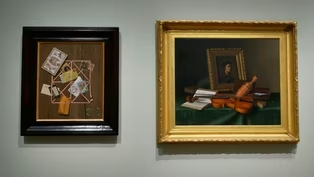
An Artist's Journey from Obscurity to Fame: The John F. Peto Studio Museum
Video has Closed Captions
Clip: S44 Ep9 | 7m 30s | Forgotten in life, John F. Peto's legacy is revived through the restoration of his home. (7m 30s)
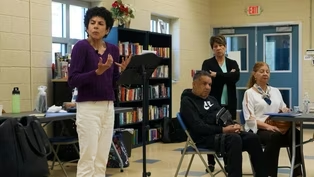
Video has Closed Captions
Clip: S44 Ep9 | 8m 39s | People & Stories / Gente y Cuentos uses literature to foster connection and community. (8m 39s)
Providing Support for PBS.org
Learn Moreabout PBS online sponsorship New Episode
 New Episode
- Arts and Music

Innovative musicians from every genre perform live in the longest-running music series.






 New Episode
 New Episode
 New Episode

Support for PBS provided by:
State of the Arts is a local public television program presented by NJ PBS