
One-on-One
Rebecca Jampol; Regina Egea & Bret Silver; Vincent Barba, MD
Season 2026 Episode 2944 | 26m 46sVideo has Closed Captions
Rebecca Jampol; Regina Egea & Bret Silver; Vincent Barba, MD
Rebecca Jampol, Co-Director, Project for Empty Space, discusses how her nonprofit empowers artists. Regina Egea, Founder & Chairman, Garden State Initiative, and Bret Silver, VP for Advancement & External Relations, Drew U., discuss a new summer program. Vincent Barba, MD, Prof. of Medicine & CMO and VP of Patient Care & Safety, Matheny Hospital examine barriers individuals with disabilities face.
Problems playing video? | Closed Captioning Feedback
Problems playing video? | Closed Captioning Feedback
One-on-One is a local public television program presented by NJ PBS
One-on-One
Rebecca Jampol; Regina Egea & Bret Silver; Vincent Barba, MD
Season 2026 Episode 2944 | 26m 46sVideo has Closed Captions
Rebecca Jampol, Co-Director, Project for Empty Space, discusses how her nonprofit empowers artists. Regina Egea, Founder & Chairman, Garden State Initiative, and Bret Silver, VP for Advancement & External Relations, Drew U., discuss a new summer program. Vincent Barba, MD, Prof. of Medicine & CMO and VP of Patient Care & Safety, Matheny Hospital examine barriers individuals with disabilities face.
Problems playing video? | Closed Captioning Feedback
Where to Watch One-on-One
One-on-One is available to stream on pbs.org and the PBS app.
Providing Support for PBS.org
Learn Moreabout PBS online sponsorship- [Narrator] Funding for this edition of One-On-One with Steve Adubato has been provided by The Fidelco Group.
PSE&G.
Powering progress.
The New Jersey Economic Development Authority.
Delta Dental of New Jersey.
We love to see smiles.
EJI, Excellence in Medicine Awards.
A New Jersey health foundation program.
RWJBarnabas Health.
Learn More at RWJBH.org.
NJ Transit.
New Jersey Sharing Network.
And by Robert Wood Johnson Foundation.
Working to create a future where health is no longer a privilege, but a right.
Promotional support provided by The Chamber of Commerce Southern New Jersey.
And by Insider NJ.
- This is One-On-One.
- I'm an equal American just like you are.
- The way we change Presidents in this country is by voting.
- A quartet is already a jawn, it’s just The New Jawn.
- January 6th was not some sort of violent, crazy outlier.
- I don't care how good you are or how good you think you are, there is always something to learn.
- I mean what other country sends comedians over to embedded military to make them feel better.
- People call me 'cause they feel nobody's paying attention.
_ It’s not all about memorizing and getting information, it’s what you do with that information.
- (slowly) Start talking right now.
- That's a good question, high five.
(upbeat music) - Hey everyone, Steve Adubato.
We kick off this edition of "One-on-One" talking about the arts, part of our "Arts Connection" miniseries.
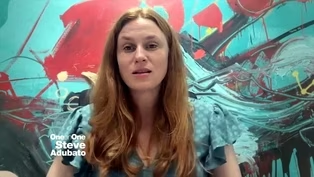
Rebecca Pauline Jampol is with us.
She is the co-director of Project for Empty Space, the website will be up.
Rebecca, so good to have you with us, thank you.
- Yeah, nice to be here, thank you for having me.
- Well, as folks are poking on the website and trying to find out more, tell them exactly what Project for Empty Space is and why it's so significant, particularly in the city of Newark.
- So, Project for Empty Space is an almost 16-year-old arts nonprofit that has four different locations, our biggest footprint being here in Newark, New Jersey.
We have a small space in Chinatown in Manhattan and a traveling exhibition truck that was retrofitted into a 27-foot exhibition space.
And our work is primarily around artists that have a social practice, who work with communities to create bodies of work.
And that is materialized through exhibitions, residencies, and public art.
- What is it about Newark and the arts from your perspective?
I mean, you understand New York City, Chinatown, you understand other places.
What makes Newark and the arts connect?
- Great question.
I actually moved here almost 20 years ago.
I was a student at Rutgers University, Newark, and I was studying the arts and I fell deeply in love with the artistic community here.
And I think the thing that really makes it quite special is the history of the arts in the city.
There's a long history of the arts, but the arts being used as a form of resistance and empowerment.
- Hold on one second.
What does that mean?
- What does that mean?
- The arts as a form of resistance.
- I mean, it is no secret that arts and activism are these two things that can work in tandem.
And when we think about the arts, they can be vehicles for social change.
And the arts in particular, particularly socially-engaged arts, can do things like give community voices.
We have exhibitions that are designed with community around things that are really important to, you know, Newark and beyond.
We do public art, which is created alongside community, with community, where narratives that are both within households and, you know, outside in our neighborhoods can be elevated to these large-scale visuals that live within our communities and we feel seen and larger than life.
So, when I say resistance, it's also these forms of giving everyday people that are walking through our neighborhoods, that are investing in our cities, a voice on a large scale, and we can do that through the arts.
- Arts in Newark and the economy of the city, the urban economy.
Talk about that.
- The arts in Newark are actually the biggest driver of traffic to the city of Newark.
There was a study that was done for Essex County looking at Newark in particularly, and 800 people were interviewed and they were asked, "Why do you go to Newark?"
And the arts was the biggest driver of it.
People want to be a part of these arts and culture spaces.
They want to see art.
They want to be around, you know, vibrancy and want to walk streets and see murals and be in restaurants where art is hanging on the walls Artists are some of the biggest economic drivers, not only because they're creating visuals and opportunities to feel enlivened, but there also are people that live in spaces that pay taxes, that eat food.
- That's right.
Pay rent.
If they don't own, they pay rent.
- Exactly, and they actually are one of the only groups that have two rents because they're paying for a studio.
And so, one of the things that Project for Empty Space does is we have a location in downtown Newark, it's about 50,000 square feet, and we offer subsidized artist studios.
Artists are not only paying a first rent or a mortgage, but they are also paying a second one.
And a lot of times that is not understood or valued.
And I think here in Newark, there's resources that really enable artists to thrive and understand the undertaking that they have, not only as culture makers and, you know, these critical parts of our city, but as some of our largest economic drivers.
- You know, it's so interesting how people very often out in the suburbs and other places have this perception of Newark.
And I'm not sure how many folks would connect Newark to the arts.
For you, before you went to Rutgers, Newark, before you saw what the city is really about and how strong the arts history and culture is of the city, do you think you would've thought that about Newark, New Jersey, and the arts?
- I mean, that's a really good question, and I think it's a tired narrative at this point.
- It's very tired.
- Yeah.
When I first moved here, there was no Prudential Center.
The reason why I fell in love with the city is because artists were the folks that were really inhabiting the spaces.
There was warehouses that were being activated by artists for their studios or for art exhibition spaces.
They were the ones that were creating this opportunity for gathering when there was no core downtown.
And so, artists have always been here.
Whether they were visible or not, they have always been here and have been the center of this city.
Our mayor, Mayor Ras Baraka, his family has a legacy of the arts here in Newark.
You know, it was the Spirit House that brought people together for street theater and for discussions and dialogue and education at one point, and so the arts are... You know, perhaps now we're hearing more stories about it or because there's more activity here, they are empowered through resources, so elevate it and there's visibility around it.
But I think the narratives around Newark at this point, if you still feel that way, you are not, you know, doing justice to yourself by not being acquainted with the city.
You're not reading about it, you're not listening about what's happening here.
Every city has an opportunity, every place has an opportunity to rebuild, and there is a real rebuilding moment now.
What I would hope for Newark as it goes through that rebuilding stage is that they create staying power for the arts, and I do think that's part of the master plan.
- And that's exactly why we're doing "The Arts Connection," is to create greater public awareness.
Rebecca, thank you so much for joining us, we appreciate it.
- No problem.
Thanks for having me.
- You got it.
Stay with us, we'll be right back.
- [Narrator] To watch more One on One with Steve Adubato find us online and follow us on Social media.
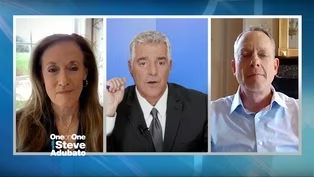
- We are honored to be joined by our good friend, Regina Egea, who is Founder and Board Chair at Garden State Initiative, one of our longtime partners, and also Bret Silver, Vice President for University Advancement and External Relations at Drew University, a great institution of higher learning.
Regina and Bret, great to see you.
- Nice to see you.
- Thanks for having us this morning.
- You got it, Regina, We had this conversation about our great friend and mentor, extraordinary leader, Tom Kean, former governor, Tom Kean.
There is a donation that Garden State Initiative, a $50,000 that your organization has made to Drew University in honor of Governor Kean for specifically what?
Because it has to do with a great Governor's School that's been going on for a while.
Go ahead.
- Exactly, the Governor's School in the Sciences at Drew University, which I know Bret will speak about.
But we were able to make that donation because we have established this award in Governor Kean's honor that you mentioned.
And he continues to be the most popular governor in the history, recorded history anyway, of New Jersey.
And it really is to not just honor all of his contributions as an incredible leader in public service as well as the private sector, his personal characteristics of integrity and honor, as well as his commitment to public service.
And one of the main goals that we have is that this isn't just a quaint notion that these are the qualities of leaders that he was successful with, but that's something that makes government work best.
And that's really what we're trying to recognize and remind everyone that there are he and others who perform like him are able to contribute to the State of New Jersey and we want to honor that.
- Absolutely.
And Governor Kean, also the former president at Drew University, leader in education for decades in this state and this nation.
Bret, pick it up from there.
Talk about how these dollars, these $50,000 grant from Garden State Initiative will be used to impact and benefit students who are looking to go into STEM, Science, Technology, Engineering, and Math, and its connection to leadership.
Please, Bret.
- Well, first of all, we're extremely grateful to have received this gift, and it's extra special to be in the name of Governor Kean, who lives on very large here at the Drew community with our alums and with everybody who's part of Drew.
The beauty of the Governor's School is that it's tuition-free.
Students from high schools all over the state are nominated by their teachers, and they come together in community for several weeks for an in-dorm, together, in-person experience where everybody is on an equal playing field.
They form an incredible community among themselves.
Many of them walk out of here and say they felt for the first time that they could actually be a scientist.
They find their voice, they find their community, they find their peers.
They do incredible scientific research.
When I go to the post session every year, I have absolutely no idea what they're talking about.
They are so far advanced in the science.
And then they go out into the world and they go to research one universities, they go to community colleges, they form part of an important scientific community in higher education, and then they go off into the world and they do incredible things in STEM fields.
- I often try to understand the connection between technology, science, and leadership.
Artificial Intelligence, STEM, and leadership.
Am I off base here, Bret?
There's a connection- - No, not at all.
No, well, I mean, this is a burgeoning curricular field, right?
I mean, things are changing.
Things are changing as we speak.
And we at Drew are thinking about this at the higher ed level.
But we have to remember that students in high school who are digital natives in the way that people of our generation are not, and our faculty isn't necessarily, they come to this program with a different perspective on digital work, on AI work.
And so I think what it's fair to say that our faculty and the students who come have an interchange, they're learning from one another.
And we are also looking at, how does AI and how does technology intersect with the future workforce and what future leaders are going to need to know?
And what we're learning and we're seeing it every day is that we don't actually know, right?
We don't know for sure.
We can't dictate to the students exactly what they're going to take from these classes and go off into their work lives, which are still six, seven, eight years away.
But there's absolutely a connection between technology, education, leadership, and we hope that a lot of the students who come through here will be on the forefront of going out into the world and taking this knowledge and redefining what some of leadership and workforce looks like.
- Regina, I want to follow up on what Bret just said.
And you and I have had these offline conversations.
And by way of background, let folks know that you do have a background in government leadership positions, including?
Please share with folks.
- I was chief of staff to both Governor Christie as well as the Treasurer while I was in the State of New Jersey.
- In the work you're doing, how important is creating trust in government for these students?
- Well, the level of cynicism, I think, and as you say, distrust in many of the structures and the, not only just government, but I think in general, our societal structures- - In media, in higher ed, in all kinds of organizations.
- Exactly.
It's just extraordinarily high, I think.
My assessment is very high right now.
And one of the ways that we can help impact that as a policy organization is to bring credible both ideas and substantial research and hold up leaders like Governor Kean in terms of this has worked, can work, and will be important for going forward for those who want to go into both public, frankly, as well as the private sector.
And the only way one rebuilds that is consistency.
And I think one of the things that I always heard, at least while he was governing, you were there, but Bret speaks about it at Drew University, is he's very community building oriented, which means you have to get to know the people, you have to- - That's right.
- Talk to them as well as incorporate.
And he's a big, as you know, his book about "The Politics of Inclusion" is one of his fundamental principles.
And these are the things that I think people really will latch onto, and that's how you build trust.
- A giant.
Tom Kean is a giant, not just in government, in the State of New Jersey and in the country, but also in higher education and education overall.
So, this, to repeat, Garden State Initiative, one of our terrific partners, a grant of $50,000 to Drew University in honor of Governor Tom Kean to support the New Jersey Governor's School in the Sciences.
To you, Bret, to you, Regina, we thank you so much for joining us.
All the best, thank you, folks.
- Thank you very much.
- Thanks, Steve.
- You got it.
Stay with us, we'll be right back.
- [Narrator] To watch more One on One with Steve Adubato find us online and follow us on Social media.
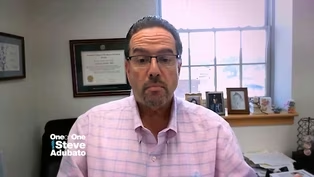
- Hi, I'm Jacqui Tricarico, Senior Correspondent for "One-on-One," and joining us now is Dr.
Vincent Barba, who is the Chief Medical Officer at Matheny Hospital located in Peapack, New Jersey.
So great to have you with us, Doctor.
- Thank you, Jacqui, great to be here.
- Well, first, for people who don't know, tell us about Matheny and the patients that you serve there.
- Great, Matheny is actually, we're celebrating our 80th year now in New Jersey.
And Matheny is, it's a bunch of things.
It's an organization dedicated to the care and education of children and adults with medically complex developmental disabilities.
So we're located, our main campus is here in Peapack where we have our 101 bed special hospital, and we have a special school here on campus for pre-K-3 up through extended high school, which, for the developmentally disabled, is 21 years of age.
Then we have group homes around the state.
We have seven group homes, and we have a day program for adults that's located in Hillsborough, New Jersey, not too far away from us.
And we also have an arts access program, which is kind of like a fine arts development program, again, for the same population of people living with disabilities.
Talking about the healthcare part of it, barriers to healthcare we know are really important to discuss when we're talking about those with developmental disabilities.
Talk about how Matheny is filling that gap in the community that you serve.
- Yeah, so our kind of specialty in the developmental disability world is the medically complex.
So our special hospital serves people in a long-term basis.
So it's a long-term care hospital.
Our length of stay is measured in years, not in days, and people basically live with us.
We've had some people that have lived with us from when they were three, four years old, and now they're in their 30s and 40s and they're living here.
The medical care for this population, and it's a very heterogeneous population of people, so some are more medically complex than the others.
We know that developmentally disabled people do have a higher incidence of chronic diseases.
They do have a higher incidence of cardiac disease and definitely respiratory diseases.
So they're really at risk in respiratory viral season from influenza, COVID, things like that.
And there are gaps.
These are usually people that are covered by Medicaid, maybe don't have access to physicians and other practitioners.
A lot of physicians and other practitioners do not have experience in dealing with this population.
So it's tough for families to find good care for their loved ones with developmental disabilities.
- Is it hard to find the staff that you need to run a facility like that because of the complex needs of the patients?
- Well, since the pandemic, it's been incredibly hard to find nurses.
Nurses have been in short supply.
A lot of people left the nursing profession.
And then to find nurses that are really drawn in, this field draws people into it, and it's not for everyone.
Not everyone is going to be able to work with this patient population.
We work with several nursing schools across the state, as well as with New Jersey Medical School in Newark to train the next generation of nurses and doctors.
We also work with clinical therapy schools, PT schools, OT schools, speech therapy schools to try to help people discover this field because it's not something that, this patient population you don't usually run across often in your training.
And some people, once they discover a place like Matheny, they realize that this is their calling.
So we work with schools around the state to try to get people interested, educated, and trained.
We have a great record of longevity for our employees here.
Every year we kind of celebrate longevity and we have people that have worked with us their entire career, since they were in school.
Some of our directors now have really never worked anywhere else.
They came here as students, and they were recruited by us, and they've been with us, and now they're directors of the organization.
So it's really, but it's tough for families.
A person with, let's say, cerebral palsy comes with a lot of equipment, so they're in a chair.
They're usually in a custom-made chair, which is kind of big.
They go into a regular doctor's office.
The doctor's office is usually not ready for them.
They may not be able to fit well in the examining room.
No one's going to be able to get them out of that chair onto the examining table.
A big piece of this puzzle is getting dental care for this population.
So you go to your dentist, you sit in the dental chair, they adjust you, and they take care of you.
It's difficult for people living with a developmental disability to go to the dentist.
There are not many dentists that are comfortable and skilled in taking care of the population and the special needs that they may have.
And there's not many dental offices that can handle physically transferring somebody to the dental chair or being able to examine them in their wheelchair.
That's something that our dentist here does a great job in.
And then, as if that wasn't complicated enough, many of the patients are not comfortable with the dental exam.
So unfortunately, what you see in this population is a lot of folks having to go to a hospital to get put under general anesthesia so they can get a dental exam.
And that's complicated, right?
Because there's morbidity.
- And risks.
- And mortality at risk for folks that are getting general anesthesia.
So our team here, we have a dentist that just works with us.
She works very closely with our entire team, especially with the speech therapist.
And what we do with our dental patients is we work on what we call desensitizing them to the dental exam so that they become more comfortable with the examination and we don't have to bring them to the hospital and put them under anesthesia.
-Speaking a little bit about that preventative care too, I just quickly, for the last minute, I want to talk about the caregivers portion of this discussion, because they're the ones who are often feeling so overwhelmed by all of the specialized appointments that they have and all these things, and preventative care often falls to the wayside.
How are you helping the caregivers through all of this as well?
- So if you think about somebody with cerebral palsy, you think about a little kid.
And mom and dad may be able to take care of their son or daughter when they're small.
But many people with cerebral palsy have very normal lifespans.
And now maybe your little son is now a six-foot tall, 220 pound man, and it's not so easy for you to pick them up and do everything that they need to have done for them every day.
So the patients that we admit to our hospital here, they cannot dress themselves, they cannot feed themselves, they cannot change themselves.
They don't use the toilet.
They can't do any of that.
So mom and dad often get to a point in their lives, usually around teenage, late teenage years, where they're no longer able to deliver that care at home, let alone get them out into the community, let alone get them to the doctors and all the specialists that they might need to see, et cetera.
And then that's when they usually entertain admitting their loved one here.
And we have a whole team that does all that for them.
But that's usually the time course for our patients is, as they get closer to adulthood, mom and dad now are also aging.
It's tougher for them to take care of their loved one and they look around.
This is the only place in New Jersey that delivers this kind of care, comprehensive care for adults.
- And those families are so lucky when they're able to find you, and find Matheny, and you and your colleagues, and the passion, and the work that you're doing.
Thank you so much for giving us some more information about the important work you're doing and continue to do in New Jersey.
Thank you so much, Doctor.
- Thank you, Jacqui.
- We appreciate it.
For Steve Adubato and myself, thanks for watching.
We'll see you next time.
- [Narrator] One-On-One with Steve Adubato is a production of the Caucus Educational Corporation.
Funding has been provided by The Fidelco Group.
PSE&G.
The New Jersey Economic Development Authority.
Delta Dental of New Jersey.
EJI, Excellence in Medicine Awards.
A New Jersey health foundation program.
RWJBarnabas Health.
Learn More at RWJBH.org.
NJ Transit.
New Jersey Sharing Network.
And by Robert Wood Johnson Foundation.
Promotional support provided by The Chamber of Commerce Southern New Jersey.
And by Insider NJ.
- (Soft music) - (Softly)Is that?
- Wow.
(Children laughing) - (Softly) It’s gonna be okay.
 New
NewDrew University's summer program for high school students
Video has Closed Captions
Clip: S2026 Ep2944 | 8m 39s | Drew University's summer program for high school students (8m 39s)
 New
NewFilling critical healthcare gaps at Matheny Hospital
Video has Closed Captions
Clip: S2026 Ep2944 | 10m 8s | Filling critical healthcare gaps at Matheny Hospital (10m 8s)
 New
NewHow the Project for Empty Space is driving change in Newark
Video has Closed Captions
Clip: S2026 Ep2944 | 8m 26s | How the Project for Empty Space is driving change in Newark (8m 26s)
Providing Support for PBS.org
Learn Moreabout PBS online sponsorship New Episode
- News and Public Affairs

Top journalists deliver compelling original analysis of the hour's headlines.
 New Episode
- News and Public Affairs

Today's top journalists discuss Washington's current political events and public affairs.
 New Episode


 New Episode
 New Episode
 New Episode
 New Episode
 New Episode
Support for PBS provided by:
One-on-One is a local public television program presented by NJ PBS