State of the Arts
State of the Arts: Tradition & Technique
Season 44 Episode 8 | 27m 46sVideo has Closed Captions
New Jersey Heritage Fellows: Yang Yi, Kimberly Camp, Omar Edwards, and Ramya Ramnarayan
New Jersey Heritage Fellowships celebrate artists who dedicate their work to passing on traditions. On this special episode of State of the Arts, meet four fellows, each bringing precision and care to the art they make: Yang Yi, performer of Ghuzeng music; Kimberly Camp, a Collingswood dollmaker, Omar Edwards, a master tap dancer, and Ramya Ramnarayan, teacher of the Bharatanatyam dance.
Problems playing video? | Closed Captioning Feedback
Problems playing video? | Closed Captioning Feedback
State of the Arts is a local public television program presented by NJ PBS
State of the Arts
State of the Arts: Tradition & Technique
Season 44 Episode 8 | 27m 46sVideo has Closed Captions
New Jersey Heritage Fellowships celebrate artists who dedicate their work to passing on traditions. On this special episode of State of the Arts, meet four fellows, each bringing precision and care to the art they make: Yang Yi, performer of Ghuzeng music; Kimberly Camp, a Collingswood dollmaker, Omar Edwards, a master tap dancer, and Ramya Ramnarayan, teacher of the Bharatanatyam dance.
Problems playing video? | Closed Captioning Feedback
How to Watch State of the Arts
State of the Arts is available to stream on pbs.org and the free PBS App, available on iPhone, Apple TV, Android TV, Android smartphones, Amazon Fire TV, Amazon Fire Tablet, Roku, Samsung Smart TV, LG TV, and Vizio.
Providing Support for PBS.org
Learn Moreabout PBS online sponsorshipNarrator: On "Tradition and Technique," a special episode of "State of the Arts," meet four New Jersey Heritage Fellows, artists whose work is shaped by precision, practice, and the passing down of knowledge.
[ Shoes tapping ] Omar Edwards is a tap dancer whose foot music has taken him around the world.
Tap-dancing is just tap-dancing, but expression inside of tap-dancing makes it special.
Narrator: For over 2,500 years, the guzheng, a type of plucked zither, has been a symbol of Chinese cultural excellence.
Yang Yi continues the legacy of the guzheng while exploring new ways for it to be heard.
Yang: I'm always welcoming different way of showcase the instrument.
For me, the most important thing is the root 'cause without the root, this instrument doesn't even exist.
Narrator: Dolls are found around the world, from ancient times to the present day.
For Kimberley Camp, the craft is both art and technique, requiring a mastery of many forms to bring each figure to life.
Camp: Dolls require the ability to sculpt, paint, sew, engineer the form, adorn.
It takes a multiplicity of skills to get there.
Narrator: And through Bharatanatyam, one of India's eight classical dance forms, Ramya Ramnarayan connects students to a living tradition, one that evolves even as it endures.
Ramnarayan: In my understanding, the word "tradition" means change.
So only when there is change, art grows, and it thrives.
Narrator: On this special episode, "State of the Arts" goes on location with masters of traditional art in New Jersey.
Announcer: The New Jersey State Council on the Arts, encouraging excellence and engagement in the arts since 1966, is proud to co-produce "State of the Arts" with Stockton University.
Edwards: Many years that I focused on tap-dancing being music, not dancing.
I don't even hear in rhythmic patterns.
When my feet are going, "Sigga digga digga digga digga digga digga," I hear, "Mmmmmmmm, mmmmmmm."
Which is being powered by -- [ Foot stomping ] But in my head, in order to get to "Zigga digga digga digga digga digga digga digga digga digga," I think, "Mmmmm."
It's just my imagination.
That's what imaginations are for.
Your imagination is so you can see God.
So you can hear music out of things that aren't presented as music.
And that's where I'm at.
My general personality has always been that of an expressionist.
I'm an idea man.
Where do I see going with tap-dancing?
Anywhere my mind can go.
My name is Omar Anthony Edwards, although you could call me "Chief."
I was born in Brooklyn, raised in far Rockaway, Queens.
And then, one day, I think my grandmother took me to the family reunion.
And that was the first time I met my cousin, Savion Glover.
[ Cheering ] Savion is in a show called Black and Blue.
I hopped a train to the Minskoff Theatre one Saturday afternoon, and I sat there, and my mind was blown.
I wasn't supposed to be on Broadway, but somehow, I got in that game.
Because I didn't know how to do choreography.
I knew how to tap-dance, sure.
So, fast-forward a little bit.
Now I'm about 16, and Danny and I have created this tap-dance group called Toe Jamm.
Danny and I would tap, I'd do some flips, we'd do some splits, have -- stand on our toes and do the whole shim-sham on our toes.
And there was a show called "Star Search."
We went 13 times, and I had booked Black and Blue.
Remember Black and Blue, the show that closed on Broadway?"
My dream show.
Now, I heard it was going on tour.
And so now I'm traveling the world.
It was really more schooling.
Glover: On tenor taps, we have Omar Edwards.
Yeah, O!
[ Applause ] Edwards: After all of that, I turned 50 years old.
And -- [ Laughs ] Yeah, that's right -- [muffled] 50 years old.
I've been to 22 countries.
I have four children now.
And the dance is pure for me.
And I'll always be in my lab, and I'll always go out and do special projects.
I have a company called Dance Medicine.
You were able to come by and see one of our holiday shows, where we got a chance to spend time with the veterans.
It was a pleasure to give them my art form and to bring my band, New York Jazz Gypsies.
Dance Medicine is about the veterans homes, juvenile detention centers, jails, hospitals, cancer wards, AIDS wards, using music, song, and dance as a healing, a radiation of healing energy.
Woman: [ Singing ] All alone, I sit home by the phone.
Edwards: I'm quite busy, enjoying the dance even more than ever.
Because you can't wave a dollar in front of my face to make me dance 'cause I don't do it to survive anymore.
I do it because I love it, and I want to know more about what I can do to contribute to it.
And if a student comes around who really wants to learn, I will dedicate and be pure with them.
I'm like a martial-arts instructor.
We're going to learn a lot about a lot of it.
Gonna learn as much as I can give you from my experience, as much as I can give you from my curiosity, as much as I can give you from the tradition of it, I just really can try to make a tap dancer, which is really just an expressionist.
Tap-dancing is just tap-dancing, but expression inside of tap-dancing makes it special.
Tap-dancing can end up anywhere.
Anywhere.
I've tap-danced at the White House, at palaces, in the park, on the street.
I've tap-danced before royalty, before Black activists.
Tap-dancing, it took me a while to figure out what the dance was for me and what it wasn't for me versus influence.
Because in America, tap-dancing has very serious racial connotations.
There was times when these Black men were on stage, smiling, when they were going through hell.
African Americans are so displaced that all of their culture is all mixed up.
And on top of that, there was a whole initiative to subdue the learning about their self and their culture.
Tap-dancing is not Black, but it is Black.
The progenitors, the forefathers are totally Black, but you can't leave out Steve Condos.
But you can't leave out Fred Astaire.
You might think I might have sold my soul because I'm a tap-dancer who smiles.
But I'm really an Omar who smiles.
Tap-dancing will die, 'cause it always dies.
But storytelling will not die.
And the tap-dancers that pay attention to the musical aspect and the storytelling aspect will live on, forever.
Even with AI, you're still going to need somebody -- some body -- to tell that story with their body, with their mouth, with their spirit, with their pain, with their joy, with their love.
That's where I come in.
So that's what I'll be doing.
Narrator: Throughout history, the arts tell the story of culture.
Up next, Yang Yi, a master of a 2,500-year-old instrument from China.
Yang: The fascinating part of this instrument is, you can be yourself, but you're not yourself.
Art is actually connecting to the spiritual world.
At that moment, I'm not me.
I forgot myself.
I just bring the energy, the emotion.
Everything feels so natural.
So I'm playing the nature, I'm playing the mountain, I'm playing the emotion and my thoughts and going through my body and reflecting.
I like to experiment.
For me, experiencing different sounds, mix, and to reflect the music.
It's just bringing my energy to the world.
[ Guzheng plays ] I'm Yang Yi.
The Chinese name is Yang Yi.
The English name is Yi Yang, but the way that we Chinese pronounce it is last name first.
I'm a musician on the art form called guzheng.
"Gu" means "ancient."
"Zheng" means "the instrument" that has at least 2,500 years of history.
It's a Chinese zither.
The traditional one has from five string to today's 21 strings, and it's been played by professional world in this shape at least since 1960s.
The instrument itself is very close to another Chinese instrument, which is already gone, but that one is more in the court.
This one is more in regular life.
[ Guzheng plays ] I started to play guzheng since I was 5 1/2.
My preschool teacher recommended me.
Actually, the number one Chinese children's performing arts group.
I was just fascinated about the sound of this instrument.
I had to do the petition to get the privilege to play this instrument.
From there, I started my career in the performing-arts group.
I collaborated with multiple orchestras, including Chinese National Broadcasting and Beijing Music and Dance Company and multiple Chinese national-level orchestras.
I moved to New Jersey in 1991.
In America, I found myself with a huge stage.
At first, I thought I had no market.
But it's amazing.
Here, I see I'm standing on a bigger stage, even though I'm always being asked, "What is this instrument?"
So I become pretty much an educator or advocating for this instrument.
I've gone through hundreds of colleges to introduce the instrument and also workshops, and I started this group called Yang Yi Guzheng Academy and Ensemble, mostly for teaching the art form in a very professional format.
in Princeton area, in New Jersey.
Deng: I think it has the characteristics of a horizontal harp, but the way that you interact with the strings is also like a guitar.
It's very bright and pure.
So I started learning the guzheng when I was 8, and I had no idea what it was in the beginning.
You start with numbers, so one, two, three, five, seven, one.
It's a pentatonic scale, which is traditional to a lot of Chinese music.
There's 21 strings, so essentially, four full pentatonic octaves.
The right hand is what actually creates the texture.
So, you can do, like, glissando, or you could just pluck, and then the left hand, it's more for pressing down on the string to create vibrato or to create new pitches.
I think that it definitely helps me stay in touch with my heritage.
It played a multidimensional role in coloring the ancient Chinese society.
It's beautiful that, through Professor Yang, that craft can kind of transcend time and transcend place, as well.
[ Guzheng plays ] Yang: Throughout the years, I've been playing so many times with different musicians, but the most memorable ones were that Chinese lute player Tang Liang-xing.
He's like a grandmaster on the pipa.
He was also the 1997 National Heritage Fellowship.
The performance was for the Chinese Lunar New Year, year of horse.
We played three songs, mostly for the traditional and the festival music.
For me, the most important thing is the root, because without the root, this instrument doesn't even exist.
It's been at least 2,500 years of history.
We do any invention, but it has to be from that point.
I'm always okay, and I'm always welcoming different way of showcase the instrument.
Chinese say... Like, "There's no sound, but that means way more than with the sound."
So it means how you can articulate it.
What do you want within that space?
Going through all these years of performance, I know both Chinese music world and the Western instrument world.
They all changed because of the possibilities.
We're collaborating, we're challenging each other, we're articulating ourselves, and the end result is always beyond what we originally thought it could be.
Narrator: In our next story, the Southern Indian classical dance Bharatanatyam is passed on from teacher to student.
Ramnarayan: I have spent all my life training in the art form Bharatanatyam.
I see dance and music as one of the best universal connects beyond the boundaries of countries or cultures or race.
It's just universal.
It's an unspoken dialogue between the artist and the audience.
So what I evoke is called bhava, and what they enjoy and feel is called rasa.
All dance forms and all music forms has the ability to bridge gaps.
My name is Ramya Ramnarayan.
I am a performing and a teaching artist.
I have been a performer since age 11.
I see myself as a lifelong student.
I did so many collaborations with so many phenomenal artists, both from the diaspora as well as outside of the Indian diaspora.
In addition, I am true to my form.
I'm a soloist.
I'm an artist who headlines in big festivals in India.
I toured in 12 cities in the United States.
Bharatanatyam is very beautiful, nuanced classical dance from India.
India has over eight classical forms.
It is closely in comparison with a form like ballet, which is mostly performed in a formal setting.
The art typically has been learned by both boys and girls.
There are two important aspects of Bharatanatyam, the first being Nritta, or abstract dance, where you would see the dancer using the movements of the body, gestures of the hands, and creates firm, rhythmic footwork by weaving geometrical and symmetrical patterns.
The footwork is done with the bare feet tapping, but also in demi-plié position.
The second aspect is expressional dance, where the dancer uses the same movements of the body, same gestures of the hand, but now each of these gestures are alphabets to dance language.
The dancer tells a story, creates an idea, and can tell an entire sequence of events.
Anything under the sun.
It's very important the dancer uses certain tools.
One is called angika, movements of the body, both minor and major limbs.
Vachika, words or poetry.
Aharya, how the dancer is dressed.
And last is Sattvika, what we feel within.
Continuing education is very important for me, as a performer as well as a teacher.
This is something that I immersed myself doing all the time.
[ Clapping rhythmically ] Ramji: I've been doing this since I was 5.
I'm 21 now.
She does a very, very good job of finding a way to connect it to our real lives in whatever way that might be, and in doing so, one, allows us to emote and accurately convey the meaning of the piece, and, two, give us a deeper appreciation for the mythology itself.
Chandrasekhar: She finds a single thread between everything that she does and keeps that as like a string of continuity.
She emphasizes the fact that you need to know music, you need to know rhythm.
And then she brings in the story.
Ramji: I think, especially growing up in the United States, when all of this culture and mythology can sometimes feel foreign or hard to connect with, her teaching for dance goes beyond just dance itself, but for life and for my understanding of my culture, as well.
Chandrasekhar: In the diaspora, there are so many different ways that culture changes and transforms, and finding that here is super important to me.
Ceyyur: Guru Ramya has been in the New Jersey area since the '90s, and I would credit her for being one of the reasons that this community has such a thriving Indian classical art scene.
She makes it accessible to the community, not just the Indian community, but the greater New Jersey arts community.
Ramnarayan: I've been selected to be a roster artist of the Young Audiences of New Jersey, and I've been working with students in over 250 public-private schools.
The assembly program is an hour-long presentation, but very interactive.
I'm engaging with all of them at the same time, introducing them to Indian dance, and how dance and music is part of all of us all the time.
Melody, rhythm, and mime is called Bharatanatyam.
All: Bharatanatyam.
Ramnarayan: They experience a little bit of Indian dance by joining me on stage in these two interactive sections.
We also do a very interesting quiz where they're just, like, so excited and interested to share all that they have noticed.
I'm just humbled by this opportunity to be able to share.
I only wanted to be a student of dance, student of Bharatanatyam, and that was what I seeked.
Then my path changed to me becoming a teacher and then a teaching artist.
In my understanding, the word "tradition" means change.
So only when there is change, art grows, and it thrives in environments.
I see tremendous hope and scope and greatness for this art thriving at its best height outside of it.
Narrator: Last on the show, Kimberly Camp preserves and reimagines the age-old art of dollmaking.
Camp: The doll really tells me where it wants to go.
And so it's a matter of free-form thought that goes into the creative process.
I literally just sit down and make whatever the heck I want to make.
Sometimes they're animals, sometimes they're humans, sometimes they're combination.
Sometimes they're creatures.
We don't really know exactly what they are.
It's there for play.
It's there for fun.
I know a piece is finished when I'm sitting at my work table, laughing my head off.
[ Laughing ] That looks like that'll be about right.
It's really all about making art that people enjoy, that makes them smile.
That's what art's supposed to do for people.
Artists broadly comment on the world.
We know what ancient cultures did because of what artists left us.
And I often tell people, if an artist hasn't made it, it didn't happen.
It's the hand sewing that gives it the attitude, the posture, you know, all of that.
And so that's why the hand sewing is really important.
My name is Kimberly Camp.
I'm a painter and a dollmaker.
I had the privilege of working in the museum field for over 25 years, and having been a painter now for 50-plus years, and it gave me the opportunity between the two of those and the dollmaking to travel, to explore different cultures.
I've been a working artist since I was 11 years old, and my first show, I was 12.
I always had fabric around, sewing machine, and was always doing something with my hands.
I was born and raised in Camden, New Jersey, and I spent as much time in the library as I did at the art supply.
I would learn -- I'd read about different cultures.
All of that sort of came together and gets combined when I make dolls.
I start making dolls first by making heads, hands, feet, horns, hooves out of clay, different kinds of clay.
And I have a whole slew of fabric that I've collected over the years in my travels all around the world, dolls require the ability to sculpt, paint, sew, engineer the form, adorn.
It takes the understanding of different fabrics and what they will do, different clays and what they will do, different beads and what they represent.
It takes a multiplicity of skills to get there.
If you define fine art as something where people are using a multiplicity of skills, well, then, dolls are fine art.
There's a definite connection between art, craft, and spirituality.
And this whole thing about folk tradition is interesting because crafts primarily were made by women.
It has been decades in the making of getting the fine-art world to accept fine craft.
It's really interesting that, in this society, in this culture, labels mean so much, especially when it comes to the creative process.
And I've had people say, "Oh, she makes African-American dolls."
I'm like, no, "I make dolls, and I'm Black American."
What's Black art?
No, I'm an artist, and I do what it is that I want.
We tend to, I think, get too hung up in categorizations.
Sometimes they help us understand.
Sometimes they obscure our ability to imagine.
The artist has the right to expression, whether it comes from any place or not.
Sometimes I do specifically make a doll for a particular purpose.
I do Orisha dolls, which come out of Yoruba-based religion.
I wanted to focus on the fact that it's immigration that gives this country its richness of texture.
My mother's side of the lineage are all Geechee Gullah, from the Carolinas, and I borrowed from Geechee Gullah stories, which were br'er rabbit tales, and made a series of dolls, mostly anthropomorphic, that had elements of them that reflected my family.
So when you say "dolls," people sort of reminisce of what you had when you were a kid.
Adults need dolls, too -- to play, to imagine, to dream.
As far back as we can go, every culture has always had dolls.
The paddle dolls from Middle Kingdom, Egypt, are the oldest ones that we know of that were made for play.
It makes perfect sense that we, as people, would make things in our image.
When I do a workshop with people, typically I will teach them how to make what it is that they want.
I'm going to put this clay in your hand.
and you make the face that you want.
I think that's the most valuable way that you teach people.
I think that most of the people who have my dolls have them in their houses.
I have my own doll collection of pieces that I've collected from around the world, and I only collect the ones that are made by hand, by regular, everyday people.
Making things brings me joy.
And when I turned 50, I said I was going to do something every day that brings me joy.
Whatever's in the news, whatever's going on in the world, when I go over to my table and start making stuff, all of that floats away.
People have more in common with each other than they think.
We're part of a continuum.
Everybody has those experiences.
They are not limited to one or the other.
And I hope that my dolls do this to remind people that we're all really the same.
Human nature has not changed in the 2 million years we have been on the planet.
Narrator: That's it for this special episode of "State of the Arts: Tradition and Technique."
To find out more about these New Jersey Heritage Fellowship artists, visit StateoftheArtsNJ.com.
Thanks for watching.
 New
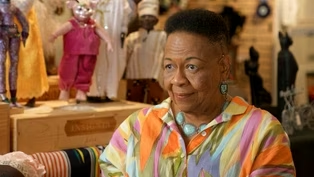
NewKimberly Camp: Dollmaking Fine Art at Play
Video has Closed Captions
Clip: S44 Ep8 | 5m 31s | Kimberly Camp brings joy to the three-millennia-old art form of dollmaking. (5m 31s)
 New
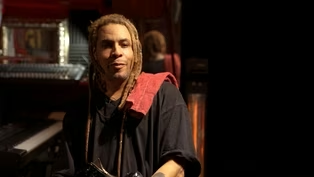
NewOmar Edwards: Tapping Into Expression
Video has Closed Captions
Clip: S44 Ep8 | 5m 44s | Omar Edwards: Tapping Into Expression (5m 44s)
 New
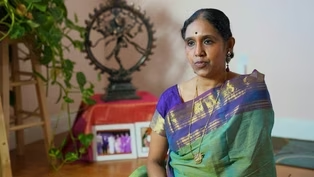
NewRamya Ramnarayan: Bharatanatyam, Tradition & Change
Video has Closed Captions
Clip: S44 Ep8 | 6m 4s | Ramya Ramnarayan connects students to a living tradition of the Bharatanatyam dance form. (6m 4s)
 New
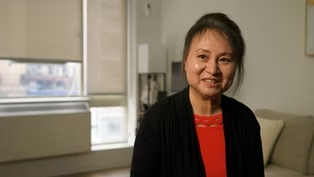
NewVideo has Closed Captions
Clip: S44 Ep8 | 6m 29s | Yang Yi, master of the guzheng, passes the ancient tradition down to her students. (6m 29s)
Providing Support for PBS.org
Learn Moreabout PBS online sponsorship

- Arts and Music
The Best of the Joy of Painting with Bob Ross
A pop icon, Bob Ross offers soothing words of wisdom as he paints captivating landscapes.











Support for PBS provided by:
State of the Arts is a local public television program presented by NJ PBS