One-on-One
Kathryn Garcia; Barbara Mintz, RDN; Jim Kirkos
Season 2026 Episode 2938 | 27m 13sVideo has Closed Captions
Kathryn Garcia; Barbara Mintz, RDN; Jim Kirkos
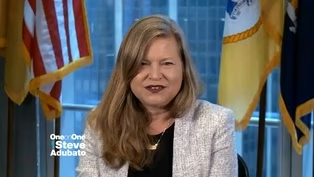
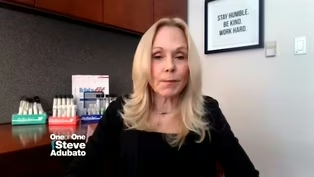
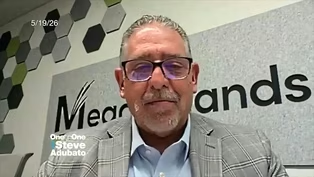
Kathryn Garcia, Executive Director of the Port Authority of NY & NJ discusses efforts to improve transportation and support commuters. Barbara Mintz, Registered Dietitian Nutritionist at RWJBarnabas Health, talks about addressing food insecurity. Jim Kirkos, President & CEO of the Meadowlands Chamber, discusses opportunities to engage with the FIFA World Cup.
Problems playing video? | Closed Captioning Feedback
Problems playing video? | Closed Captioning Feedback
One-on-One is a local public television program presented by NJ PBS
One-on-One
Kathryn Garcia; Barbara Mintz, RDN; Jim Kirkos
Season 2026 Episode 2938 | 27m 13sVideo has Closed Captions
Kathryn Garcia, Executive Director of the Port Authority of NY & NJ discusses efforts to improve transportation and support commuters. Barbara Mintz, Registered Dietitian Nutritionist at RWJBarnabas Health, talks about addressing food insecurity. Jim Kirkos, President & CEO of the Meadowlands Chamber, discusses opportunities to engage with the FIFA World Cup.
Problems playing video? | Closed Captioning Feedback
How to Watch One-on-One
One-on-One is available to stream on pbs.org and the free PBS App, available on iPhone, Apple TV, Android TV, Android smartphones, Amazon Fire TV, Amazon Fire Tablet, Roku, Samsung Smart TV, LG TV, and Vizio.
Providing Support for PBS.org
Learn Moreabout PBS online sponsorship- [Narrator] Funding for this edition of One-On-One with Steve Adubato has been provided by NJ Transit.
Your ride to the world’s game.
United Airlines.
PSEG Foundation.
Kean University.
Where Cougars climb higher.
Newark Board of Education.
Robert Wood Johnson Foundation.
Working to create a future where health is no longer a privilege, but a right.
The Fund for New Jersey.
Horizon Blue Cross Blue Shield of New Jersey.
And by New Jersey Sharing Network.
Promotional support provided by NJ.Com.
Keeping communities informed and connected.
And by BestofNJ.com.
All New Jersey in one place.
- This is One-On-One.
- I'm an equal American just like you are.
- The way we change Presidents in this country is by voting.
- A quartet is already a jawn, it’s just The New Jawn.
- January 6th was not some sort of violent, crazy outlier.
- I don't care how good you are or how good you think you are, there is always something to learn.
- I mean what other country sends comedians over to embedded military to make them feel better.
- People call me 'cause they feel nobody's paying attention.
_ It’s not all about memorizing and getting information, it’s what you do with that information.
- (slowly) Start talking right now.
- That's a good question, high five.
(upbeat music) - Hey, everyone, Steve Adubato.
We kick off the program with the executive director of a very important agency, the Port Authority of New York and New Jersey.
Kathryn Garcia is the first female to serve in that post with an impressive background in public service.
Kathryn, it's an honor to have you with us.
Thank you.
- I'm so happy to be here.
- Talk about your background leading up to this role.
- Certainly.
So in my prior role, I was working for Governor Hochul, running operations for the State of New York, which literally was everything, from the Port Authority to the National Guard.
And then prior to that, I was commissioner of New York City sanitation, so I knew a little bit about snow, and prior to that, the COO of New York's water supply.
- And, again, check out previous interviews we've done with the chair of the Port Authority of New York and New Jersey, Kevin O'Toole.
Check out those interviews.
We've talked about a whole range of things, but Kathryn, from your perspective as you come in, the top two or three priorities for you as the leader of the Port Authority on the staff side, if you will.
- In terms of how we are strengthening our staff, I mean, it is absolutely critical that we are hiring the best and the brightest to push this agency forward.
We have a long and storied history of building great things, and I wanna see us continue to do that.
We have to execute on the Midtown Bus Terminal, but also really see the AirTrain get done at Newark so that we can make room for a new Terminal B.
- Let's go back to the bus terminal over on 42nd Street, Eighth Avenue, and the surrounding areas.
Why is that so important, Kathryn?
- When you think about it, over 200,000 people are moving through there every single day, how their experiences in that facility, how we are operationally?
If the bus gets stuck, and I can't get you out of the bus terminal, you're late to your little league game, you're late to the parent-teacher conference, you're late to your gym appointment.
Whatever you're doing that's personally important, now you're not gonna be able to do it.
And time is really important to people these days, and it's about giving them that.
And they should enjoy their experience as they're moving through any of our facilities, whether it's the Midtown Bus Terminal or it's any of our airports or across any of our bridges or tunnels.
- Can we talk about PATH?
Where are we with the improvements on PATH, Port Authority Trans-Hudson, PATH?
- So every day, every line is running.
We started that on Sunday, so now you have direct access.
You don't have to stop at Hoboken.
So we have made it so that there's a lot more service, and it is because of the investment that we made, the $430 million of investment in PATH Forward.
But also our customers were extremely patient as we did over 15,000 linear feet of new track to prepare for this service.
And you know, we've got a lot more weekend service happening.
We're seeing real upticks there.
- Yeah.
Again, we'll put up the Port Authority website, and also the Port Authority, an underwriter of our programming.
I often wonder about this, as we talk about Newark Airport, for those of us who fly in and out of Newark Airport, we see certain progress taking place, Terminal A, but there are other terminals.
Talk about what else is going on there, Kathryn?
- Absolutely.
So Terminal A, obviously, we are gonna have to get them a new display case for the amount of awards they're winning.
But we are moving the AirTrain from its current location, so it will be closer to the highway system away from the semicircle, that will give us a lot of room to build an actual modern Terminal B. The Terminal B of today at Newark is really subpar, and it's not gonna be overnight 'cause, obviously, it's gonna take us time to move the AirTrain and then build a new terminal.
And in the meantime, we are gonna try and make the customer experience better in Terminal B. There's a lot of brown.
We seem to have liked the color brown.
- And that's changing.
- Brown carpeting.
Brown walls.
- Okay, that's changing.
- We're working on making a little bit of a refresh there as we hold ourselves over until we can build the new terminal.
- What do you believe the impact of the Airbus will be, excuse me, the AirTrain on Elizabeth, on the community?
Because Newark Airport is in two cities, Elizabeth and Newark.
Please, Kathryn.
- So, you know, there are almost 25,000 people who work at Newark every day.
Being able to see that much economic impact, it is important that both the cities of Elizabeth and the cities of Newark really benefit from that.
And that's also why, at least in the South Ward of Newark, we're creating another access point to the AirTrain, New Jersey Transit and Amtrak, that has never been there before.
You know, when you give people transportation opportunities, you give them economic opportunity.
- You know, you mentioned New Jersey Transit.
We actually just did a panel discussion that included Kris Kolluri, the executive director of New Jersey Transit, talking about FIFA and moving people and how complicated that is.
- Yes.
- What is the role of the Port Authority in moving people being involved in the FIFA World Cup over at the Meadowlands at MetLife?
- Absolutely, like, we've been working very, very closely with Kris.
I mean, he is gonna carry the lion's share of this.
And our two roles are, one, to make sure that we can move regular New Jersey commuters, so on New Jersey Transit buses and on the PATH train.
But in addition, we have to make it so that all of the special FIFA buses can move through the Lincoln Tunnel effectively.
So those are our two real roles is ensuring that the Lincoln Tunnel moves smoothly and prioritizes those buses, as well as to pick up the slack, because all of these Midtown trains are going to be headed to the Meadowlands and not to where they usually go.
- Last question.
We have a sister series called "Lessons in Leadership" I do with my colleague, Mary Gamba, and we talk all kinds of leaders.
Kevin O'Toole has been on and others.
We try to ask what the most significant leadership lesson people in very prominent positions like the one you have is.
What would you say the number one leadership lesson you've learned in all of your leadership roles is?
Tough question, I know.
- Oh, no, very tough question.
And by the way, you should never follow Kevin O'Toole in a speaking engagement.
- True.
- You know, I think the actual most important lesson I learned, particularly in public service, is that you have to make decisions.
Waiting for perfect information is almost never gonna happen.
And so you have to live with what you decide and learn from them if they aren't the right decisions.
You're never gonna be perfect.
- Well said.
Kathryn Garcia, Executive Director of the Port Authority of New York and New Jersey.
Kathryn, thank you so much for joining us.
We appreciate it.
- Thank you so much for having me.
- You got it.
Stay with us, we'll be right back.
- [Narrator] To watch more One on One with Steve Adubato find us online and follow us on Social media.
- Recently, my colleague on "Lessons in Leadership," our sister program, Mary Gamba and I, sat down and talked with Barbara Mintz.
She is a registered dietician, nutritionist, and Senior VP of Social Impact and Community Investment at RWJBarnabas Health, a longtime underwriter of public broadcasting.
We talked about food insecurity, SNAP benefits, right?
What is happening to replace those SNAP benefits that have been cut.
And, also, the impact on nutritious food, I can get that out, and people's health.
Barbara Mintz.
Check it out.
Mary and I are thrilled to be joined by our good friend, Barbara Mintz, Senior Vice President, Social Impact and Community Investment, RWJBarnabas Health.
One of our longtime partners and underwriters.
Barbara, tell everyone your background in nutrition.
What it is.
- Yes, I'm a registered dietician.
I've been doing this work now for 20, 25 years.
Started out at Newark Beth Israel Medical Center as a nutrition counselor and then kind of worked my way through some of what we're seeing today, which is the social determinants of health.
Specifically, food insecurity.
- Let's talk about food insecurity.
How serious is the issue?
And what is RWJBarnabas Health doing to address it?
- Well, it certainly is one of the social determinants of health that is most closely linked to our health outcomes.
I mean, many of the diseases that we're seeing in our emergency rooms and in our primary care offices are linked to food intake.
Diabetes, heart disease, obesity.
All of those things are related to what we choose as food.
However, if we don't have access to healthy food, we're not going to be able to really address those things in our own health and wellness.
So what we do, as a system, is try to look at food insecurity and nutrition insecurity at the same time.
I guess most people just look at it as a lack of food.
But it really is not just a lack of food.
It is a lack of healthy food.
So, with that, you have to be able to provide access to this healthy food.
So, as a system, we address the issue at its root cause, which is making sure that we do have access through developing models, business models and distribution models, for food, healthy food, vis-a-vis farmers, et cetera, to get into the places that it's needed the most.
Because food insecurity really is not just, it's not the lack of food per se, especially in the Garden State here.
It is the lack of the ability to get it to the places where it needs to be the most.
- Absolutely.
Mary, jump in.
- Barbara, you talked about the farmers.
And you talked about a whole network, a cohort of people that come together.
That raises a question that you and I had talked offline a little bit about, which is Harvest.
And the little bit that I know about it is super inspiring.
It's a collaboration.
It's bringing together people.
It's partnerships.
Steve and I talk on "Lessons in Leadership" all the time about the importance of partnerships and bringing people together.
Can you tell us what Harvest is and the partnership that you are helping to collaborate with them?
- Well, Harvest is a kind of a way to pull all of this together.
It provides, not only a place to aggregate and distribute this food, because we are in partnership with farmers, over 30 of them, throughout the state of New Jersey, but it's also a place to incubate businesses.
Food businesses, if you will.
It's right on Halsey Street in Newark.
And we will be able to connect with local restaurateurs, and entrepreneurs, and culinary artists in those spaces to bring their expertise into the city of Newark as well as develop a business model for this particular situation.
So we also have a teaching kitchen, which will allow us to bring in a registered dietician to come in and teach the reasons why we should be choosing healthy food and how to cook it, so to speak.
It really does, to me, as somebody who has been doing this work for a while, bring together the three critical partners that you mentioned, Mary.
One of them is agriculture, healthcare, and education.
Without those three together in this perfect trine, we're never gonna be able to move the needle in this space.
So this gives us an opportunity in not that big of a space, about 8,500 square feet, to really pilot this effort, if you will.
Get our farmers connected to a good business model.
Get our folks connected to the proper nutrition education as well as help the local businessman.
- I'm gonna follow up on this.
The SNAP Navigator program.
What is it?
And why is it so important, Barbara?
- Well, it's a program that we started with the Department of Family Development last year.
I think we're the only healthcare system in the country to do something like this and take this on.
But we've hired 12 staff navigators and two managers of these navigators to actually embed themselves in the communities within our catchment areas in all of our 12 acute care hospitals.
So this model's different because they're not only connected with our community health worker program, which is an inpatient model, if you will.
Those folks are embedded in our emergency rooms.
So they could get to connect with those who screen food insecure.
But these folks are deployed to community partners.
They're in churches.
They're in schools, local bodegas, supermarkets, et cetera.
Just to make sure our community members, whether they're our patients or not, are connected with this important benefit.
SNAP is really also an economic driver- - That used to be called, I'm sorry, Barbara.
It used to be called food stamps, right?
- Yes, they did.
Now, it's Supplemental Nutrition Assistance Program.
That's what it's called.
- Right, and connecting people.
I'm sorry for interrupting, Barbara.
But connecting people.
- It's okay.
- Good.
That's so hard.
'Cause people are like, where do I go?
And you're helping them do that.
Talk about that more.
- Yeah, so I think since RWJBarnabas Health is a trusted source for many things in health, having us in there as a navigator helps connect them to the social services.
Not just the clinical services.
So it really does- They know to come to us and all of our community partners within our local community.
So it's a corporate-driven initiative.
But it's locally implemented.
I mean, very hyper locally implemented.
So we work with our community health leaders in each one of the facilities to make sure that they are reaching out to folks who, and letting them know that we are here, and we can get them an application, and get them on their way to receiving SNAP.
- Navigating the governmental process to get the services one needs.
Easier said than done.
Go ahead, Mary.
- Barbara, you talked about access and you talked about education.
And those two, in my mind, because the access of the fast food, of the, every day you turn on the TV, there's a new $5 meal.
There's a new $3 meal.
I'm like, how do you get all this food for only $5?
How are you moving that needle that you talked about earlier when it comes to helping individuals to understand the difference between fast food, right, a $5, $6 biggie bag, whatever they are, and having access to that healthier food?
How do you help to change that dialogue?
Because I know, for me, it tastes really good.
- Yeah, unfortunately it does.
It's almost predatory in nature if you look at some of the underserved areas.
(Steve laughing) It is.
I mean, it's cheap.
- It's so good.
- And it's like, if a mom is really struggling, she's working a job and two jobs, and has all of these kids, and she needs to feed them, she can go right through a drive-through and get all of this unhealthy food at a very affordable price.
So we try to help folks navigate that environment, if you will.
We have many curriculums.
One of them is our KidsFit program that teaches kids and their families how to make better choices within this environment and also how to shop with their SNAP.
So if they go into a supermarket and they pick the right ingredients for a healthier meal, it could also be affordable to them.
Also, understanding that, sometimes, time is a huge issue.
And it's not easy to prepare meals for kids if you're working in, and even if we weren't living in an underserved area, it would be a difficult thing to do.
So to really drive that home at an early age with family members does help them to understand that there is a connection between how they feel, how they perform in the classroom, or on the playing field, or at work with the food that they're eating.
- Before I let you go, Barbara, what is a food pharmacy?
- A food pharmacy is not your typical food pantry.
It is a clinically integrated model that actually provides, not only healthy food access to those who screen food insecure, but also consultations with a registered dietician.
They get referred by their primary care or their specialty doctor.
They can go meet with a dietician and get access to healthy food in a very dignified, supportive manner where they will be shopping with a dietician to get their food, healthy produce from our farmers that I mentioned before, and in a partnership with the Community Food Bank of New Jersey twice a month.
So it makes sure that they are still connected to their clinical care that they need and also get the food and the education that they need to stay healthy and well or manage their chronic conditions.
- Barbara mentions the Community Food Bank of New Jersey, one of our longtime partners, creating greater public awareness around food insecurity.
The RWJBarnabas Health website will be up.
This has been up the entire segment.
Go on that site.
Find out more.
Navigate it.
Barbara just used the word, "Navigate."
Navigate through the system to find out different initiatives and programs at RWJBarnabas Health.
Barbara, we thank you, and the team at RWJBarnabas Health, for being important partners in the community and making a difference every day.
Thank you, Barbara.
- Thank you, Steve.
Thank you for your support.
- You got it.
Stay with us.
We'll be right back.
- [Narrator] To watch more One on One with Steve Adubato find us online and follow us on Social media.
- We're now joined my good friend Jim Kirkos, who is President and CEO of the Meadowlands Regional Chamber and also a trustee of the Caucus Educational Corporation, our not-for-profit parent company.
Hey, Jim.
How you doing, buddy?
- Hey, it's good to be with you today.
I'm doing great.
Thanks for having me.
- You got it.
Talk to us.
Before we do the Convention Center, the Meadowlands Convention Center, give me a minute on why the World Cup, FIFA World Cup, you've been talking about this with us for five years now.
Why is it a big deal?
All the challenges... By the way, check out our panel discussion on all the transportation challenges and other issues, the cost, who's paying, all that.
That's on a previous program we did.
Why are you bullish on this?
- Listen, it is the greatest game in the world, and three billion people are gonna watch the World Cup final.
And despite all the challenges, it's great for New Jersey.
I think, overall, New Jersey benefits top to bottom throughout the entire state.
You know, while I'm a champion of the Meadowlands, that's my job, I think this is really good for New Jersey as a whole.
You know, today they talked a little bit about in the news about four countries having their base camps here in New Jersey.
We got nine different countries playing games during the group round games and maybe as many as 15 different countries visiting us.
It's an amazing thing and we should embrace it.
- What's the Flag Cities 2026 initiative, the fan festivals?
- Flag Cities is local fan festivals that we conceptualized three years ago, making sure that we could bring fan festivals into local communities so that local businesses had an opportunity to do some business, local residents have an opportunity to touch and feel the World Cup, especially for those that are not gonna have tickets to the game, and, more importantly, to create a there there in New Jersey so that domestic and international travelers, those that do come here, have something else to do here in New Jersey, and we want to keep 'em on this side of the Hudson River.
- Talk to us, we've been talking about the Meadowlands Convention Center for a while now.
What is it?
What's its cost?
And where are we in the process, Jim?
- Okay, so let me take you back just quickly.
We started out a bunch of years ago, you know I've been talking about this for lots of years, but we started out, and it didn't really become real until we hired an entity out of Chicago called Hunden Strategies to do a market analysis and an economic impact.
And when they completed that, it showed that a convention center, multi-use, youth and amateur sports, meetings and conventions type facility, replacing the arena at the Meadowland Sports Complex could generate $30 billion a year over a 30-year period.
There isn't a project anywhere in New Jersey that can generate $30 billion.
So we went to the Murphy administration and said, "Hey, you need to take a look at this.
We think this is worthy of further investigation."
And through the efforts of Paul Sarlo, Senator Sarlo from District 36, he helped us get a half a million dollars from the legislature to start as seed money.
And then Governor Murphy provided us with $2 million to do a full scoping assessment, which is the next level of feasibility study.
It's basically a demonstration project to take it to the next level and bring it to the next governor, which is now Governor Sherrill, and present them with the real facts that says, "Here's what it would cost to build, here's what it would look like, here's the impact it would have, and let's think about whether this is the right thing to do and move forward."
- Where is Governor Sherrill on this?
- Well, so her administration has been warm to the idea, but she still needs to see all the facts, and she hasn't seen those facts.
In her defense, we haven't presented it with her.
We hope to do that by the end of June.
And listen, she's gonna be really occupied with World Cup, so it's likely to take place after World Cup, but by the time the end of the summer's here, we will have briefed all those in the Sherrill administration about the full impact of what this amazing facility could do.
- Let's try this, Jim.
I bring this up with you virtually every interview we have.
Talk to us about the transportation slash traffic challenges potentially connected to a convention center and how they would be dealt with.
- So one of the criteria for giving us the money, the $2 million in the scoping assessment, Diane Scaccetti, who was the Governor's chief of staff and a former DOT commissioner, she had said, "Listen, you know, we really need to do a full transportation master plan for the complex."
'Cause over the years, that hadn't been done.
Each individual stakeholder, American Dream, the racetrack, the stadium, they did their own transportation plan for their own project, but there hasn't been one done for the complex.
We're doing that.
We're in the final stages of that right now.
We hired a fabulous traffic engineering firm to do that and we're gonna present a whole series of recommendations on egress and ingress to the complex and some other items there that will have a real long-lasting impact, both with the convention center and without a convention center.
- You're one of our media partners.
We talk about this a lot in terms of getting information out, how challenging it is, finding your audience and getting information to those folks, particularly in such a digitally-focused universe we're living in.
What are the most significant developments at the Chamber, particularly as it relates to communicating with your members?
- Now, listen, I think the interesting thing is people want tidbits of information and you've gotta feed them regularly, right?
And so that's what we're doing.
We've established Meadowlands Media as an outgrowth of the Chamber as a means of communicating regional and community-related events.
We have "Meadowlands Magazine."
But when it comes to the communication side, you have to show, there's gotta be mechanisms and digital mechanism, internet-based, web-based, for you to be able to communicate all that's there.
People want, they wanna read and understand at their own time and their own leisure, right?
And people will find time.
- Put you on the spot here.
- Yep.
- We're doing a series called Start Strong NJ.
The organization Start Strong NJ is all about childcare.
Connect for us, your members, the ability of your members to hire people, disproportionately women, men as well, but at the same time, deal with childcare issues.
My question is, how important is childcare to your members, Jim?
- Not only childcare, Steve.
I think since the pandemic, I mean, family care is really important, and I've seen more and more companies and more and more small, especially small and mid-sized companies, adopting policies in their organization that were typically just for large companies relative to flexibility, some remote work, and just making sure that people have the ability to take care of their children, take care of their family, because that's what keeps employees loyal and keeps them strong to their mission of their, and the job that they do.
- Jim Kirkos, President and CEO of the Meadowlands Chamber, and their website has been up.
Check out Meadowlands Media as well, our media partners.
Jim, we wish you all the best and let's have a great FIFA World Cup.
Tickets are tough to afford, but there are all kinds of ways you can connect to it, and let's make sure everyone is safe and gets to where they need to go.
Jim, thank you, my friend.
- Always good to be with you, Steve.
- You got it.
I'm Steve Adubato.
That's Jim Kirkos.
We'll see you next time.
- [Narrator] One-On-One with Steve Adubato is a production of the Caucus Educational Corporation.
Funding has been provided by NJ Transit.
United Airlines.
PSEG Foundation.
Kean University.
Newark Board of Education.
Robert Wood Johnson Foundation.
The Fund for New Jersey.
Horizon Blue Cross Blue Shield of New Jersey.
And by New Jersey Sharing Network.
Promotional support provided by NJ.Com.
And by BestofNJ.com.
- (Narrator) Visitors traveling to New Jersey for the FIFA World Cup can use New Jersey Transit Services statewide.
Train bus, light rail, and paratransit services connect riders to Newark Liberty International Airport MetLife Stadium, New York City, and communities throughout New Jersey.
New Jersey Transit Safe Passage Initiative raises awareness about the signs of human trafficking and encourages reporting suspicious activity.
Travel information, schedules, and safe passage resources are available at njtransit.com.
 New
NewExecutive Director of Port Authority talks public transit
Video has Closed Captions
Clip: S2026 Ep2938 | 8m 24s | Executive Director of Port Authority talks public transit (8m 24s)
 New
NewHow food insecurity is connected to the economy
Video has Closed Captions
Clip: S2026 Ep2938 | 10m 23s | How food insecurity is connected to job creation and the economy (10m 23s)
 New
NewJim Kirkos discusses opportunities & the 2026 FIFA World Cup
Video has Closed Captions
Clip: S2026 Ep2938 | 8m 59s | Jim Kirkos discusses opportunities & the 2026 FIFA World Cup (8m 59s)
Providing Support for PBS.org
Learn Moreabout PBS online sponsorship New Episode
- News and Public Affairs

Top journalists deliver compelling original analysis of the hour's headlines.

- News and Public Affairs

FRONTLINE is investigative journalism that questions, explains and changes our world.
 New Episode
 New Episode
 New Episode



 New Episode
 New Episode
 New Episode

Support for PBS provided by:
One-on-One is a local public television program presented by NJ PBS