One-on-One
Living organ donor shares her brother's lifesaving legacy
Clip: Season 2026 Episode 2951 | 9m 47sVideo has Closed Captions
Living organ donor shares her brother's lifesaving legacy
On-location at the NJ Sharing Network 5K Celebration of Life, Senior Correspondent Jacqui Tricarico speaks with Alisha Langford, Sister of Organ Donor Nicholas Dono, about her unique relationship to organ donation, both as a living donor and in honoring her brother's lifesaving legacy.
Problems playing video? | Closed Captioning Feedback
Problems playing video? | Closed Captioning Feedback
One-on-One is a local public television program presented by NJ PBS
One-on-One
Living organ donor shares her brother's lifesaving legacy
Clip: Season 2026 Episode 2951 | 9m 47sVideo has Closed Captions
On-location at the NJ Sharing Network 5K Celebration of Life, Senior Correspondent Jacqui Tricarico speaks with Alisha Langford, Sister of Organ Donor Nicholas Dono, about her unique relationship to organ donation, both as a living donor and in honoring her brother's lifesaving legacy.
Problems playing video? | Closed Captioning Feedback
Where to Watch One-on-One
One-on-One is available to stream on pbs.org and the PBS app.
Providing Support for PBS.org
Learn Moreabout PBS online sponsorship(upbeat music) - Upbeat Music - Hi, I’m Jacqui Tricarico, Senior Correspondent for One on One, and I’m here at the New Jersey Sharing Network’s 5K celebration of life here in New Providence, New Jersey, talking to all types of different people who have been impacted by organ donation and tissue donation, and joining me now is Alisha Langford, who is the sister of Nick and the team "Liver Up for Nick" here today being represented at the 5K.
It's so great to have you with us.
- Thank you for having me.
- Well, first, tell us about your brother, Nick.
- My brother was someone who loved to live life.
He was unapologetically himself all the time.
He loved the summer.
He loved disappearing on his boat, in his jet skis.
And he had countless friends.
He would talk to anyone and everyone.
My joke is like he would talk to dust.
So like his reach was very broad and like he was someone who, the first time you met him you felt like you knew him your whole life.
Like he left nothing unsaid.
He was an amazing, amazing human that would do anything for anyone, which is how we found ourself here.
- Yeah, and you also, you're describing Nick, but it sounds like you're talking about yourself a little bit too, because you did such an amazing thing when organ donation kind of first came into your family's life.
You were an organ donor for your brother.
Talk about that experience.
- So my brother was diagnosed when he was very young.
He was about 12 years old when we found out that he had PSC, which is a rare liver disease.
And we knew at that moment that he would need a transplant inevitably.
And in 2016, he was officially listed.
And when he was listed, then I began the testing process for the living donorship.
- [Jacqui] How old were you?
- [Alisha] I was at that point 26 years old.
And he was 20.
We're four and a half years apart, so he was 21.
- [Jacqui] Was that always something that was in the back of your mind?
- [Alisha] It was never a question for me.
Like as soon as we found out that he would need it, like that was always my intention.
When he was first diagnosed, he was told that he wouldn't be a candidate for a living donor because they only take a segment of your organ and transplant it, and they felt that he would need the whole, not a partial.
But as we went to different doctors as he aged, that transitioned to where he was eligible for a partial and that's where I came into play.
So I don't even think like he was formally listed and I was already calling the transplant center like, when do I come in?
- Because you need to go through testing to see if you're a match.
So talk about that.
And also you touched upon it, but the liver is a unique organ in that you can take part of your liver and donate it being a living donor and it will regenerate.
Regenerate.
Talk about that because a lot of people don't know that, I think.
- It's one of the only organs in your body that regenerates.
Obviously your skin does also.
They can take up to 60% of your organ, which is what they took from me.
They took my right lobe.
So my joke was like he was all right and I was all left.
So they left me with 40 and they've made so many advancements now with that surgery.
My understanding is that now they can even do it laparoscopically, whereas that was not the case in 2017 when we did it.
It's the best thing that I've ever done.
It's I think the proudest thing I've ever done.
Like on the way to the hospital that morning because you have to check in and they sit you side by side and you're just kind of like waiting for the surgeons to come in.
And he said, "This is my new birthday."
And then when he woke up, he told me that I was his hero and that he loved me.
And I don't feel like a hero.
It's just like, if you know that you have a key to someone's happiness, tomorrow's, hugs, like sunny days, I can't fathom not giving that to someone.
And like allowing them the opportunity that you have.
And for me, that's what it was about more than anything.
And now like I see posters of like kidney needed and my husband's like, "Absolutely not."
- Who else can I give.
Oh yeah.
- Honestly is one of the most rewarding experiences I think of my lifetime.
- And you gave your brother this incredible gift.
And he was able to live so many beautiful years with you and your family.
But then tragedy hit.
And your brother passed away, not from the liver disease, right?
- Totally separate.
He had a brain aneurysm.
He was 29 years old.
No one had more medical workup than Nick.
So it really came as a shock.
And believe it or not, my brother was not a registered organ donor.
Because of all of his illnesses, he believed - - He thought maybe he wasn't the right candidate.
- Yeah, he believed that he wouldn't be able to.
And him and I had had a lot of conversations.
We were obviously very close and we always knew that like if we ever had to make the decision that that was the decision to be made, that if something could be given, then that's what we would want to do.
So when they shared the news with my family and I that he was brain dead and that there was no recovery possible, that was my first question was, can we donate his organs?
- What was he able to donate?
- He was able to donate his heart.
And we got the letter three weeks later that it went to a 65-year-old man that I may never know.
And it offers me such a sense of peace in my brother's passing because like his heart is still beating somewhere.
Like right now as I'm sitting here, that person is getting to love their family the way that Nick did.
- What does that feel like for you to know that he's living on in that way?
- I think it offers me a sense of, like I said, peace, but it also offers me a sense of purpose.
Like we think that death is a closure of a chapter, but for Nick and for us, it's the opening of a chapter that I may never get to read.
And sometimes that's okay.
But just knowing that there's someone out there that has a piece of him is incredible for me.
And they are so lucky.
Not just because he's mine.
But because there's families like me and us every day that make that choice, that say to themselves, "This is the darkest day of my life."
But it could be somebody's best.
And that gift is the largest you could ever give to anybody.
- And it's such an emotional rollercoaster on so many different levels.
Talk about your team here today.
"Liver Up for Nick."
You said over 45 people.
Friends and family.
Talk about the people that have joined you on this journey here today at this beautiful celebration of life.
- [Alisha] So we really look forward to it every year.
Everyone's like, "What's the T-shirt going to be?"
And I'm like, "I like last year's T-shirt, so we're going to keep it."
- This one' great too.
- Yeah, its his little character on his jet ski.
- He's on his jet ski, I love that.
- Where I want to think he is right now.
Yeah, we have 45 people.
It's our yearly thing.
It's celebrating him, but it's also like paying it forward through the funds that we raise, the awareness that we raise.
It allows people to be more open to organ donation and know what the Sharing Network offers and understand like they are a community.
It's not just a nonprofit.
Like these are people, these people care.
They are an extension of your family.
- They really are.
And just even the people that you meet along the way that other people are sharing in similar experiences all gathering here today.
And you had an opportunity or you're having an opportunity here today to walk through the building.
And the building has a very unique parts of it that are honoring those donors all the time of the landscape of life wall that you're going to be walking by.
How important was it for you today to be a part of what's happening inside the building too?
- Me personally, I've never formally been in the building.
I've only been in here once and it was in and out.
I haven't been able to like see my brother's name on the wall, but to know that like people walk past it every day and like sit next to it and eat lunch and like ponder.
And he's one of many people that have paid it forward, which is beautiful.
And to know that like his name exists inside of these walls is also a really beautiful thing.
I'm excited to see the building and see like all of the intricacies of it's not just about names, but it's about experiences.
It's about like their faces and their photographs and their accomplishments and all of the things that they were able to do within their lifetimes.
- Yeah, and you being able to sit here and honor your brother with us, we appreciate that so much.
And letting everybody know just the important things that you as a living donor did for your brother saving his life and then how he paid it forward to so many others.
Thank you so much.
- Thank you so much for having me.
- Thank you, Alisha, we appreciate it.
- It's been an absolute pleasure.
- [Narrator] One-On-One with Steve Adubato is a production of the Caucus Educational Corporation.
Funding has been provided by New Jersey Sharing Network.
Hackensack Meridian Health.
EJI, Excellence in Medicine Awards.
A New Jersey health foundation program.
Horizon Blue Cross Blue Shield of New Jersey.
PSEG Foundation.
New Jersey Manufacturing Extension Program.
South Jersey Industries.
The Turrell Fund, a foundation serving children.
And by The North Ward Center.
Promotional support provided by Meadowlands Media.
And by Insider NJ.
- You are your child's best advocate.
No one cares more about your child's health, safety, development, and wellbeing more than you.
Empower yourself with the vaccination information you need to make the best decisions for your child.
Hackensack Meridian Health can help.
Learn more about fact-based information at hackensackmeridianhealth.org/ vaccine-facts and always talk to your child's pediatrician.
 New
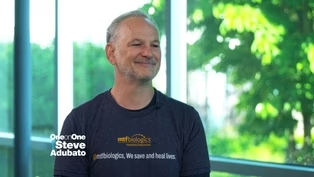
NewPresident & CEO of MTF Biologics describes tissue donation
Video has Closed Captions
Clip: S2026 Ep2951 | 8m 6s | President & CEO of MTF Biologics describes tissue donation (8m 6s)
 New
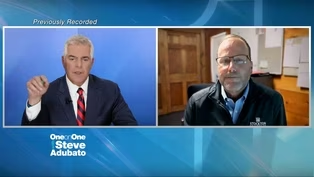
NewStockton University Marine Station pioneering research in NJ
Video has Closed Captions
Clip: S2026 Ep2951 | 7m 55s | Stockton University Marine Station pioneering research in NJ (7m 55s)
Providing Support for PBS.org
Learn Moreabout PBS online sponsorship New Episode
- News and Public Affairs

Top journalists deliver compelling original analysis of the hour's headlines.
 New Episode
- News and Public Affairs

Today's top journalists discuss Washington's current political events and public affairs.
 New Episode
 New Episode
 New Episode
 New Episode
 New Episode
 New Episode
 New Episode
 New Episode
 New Episode
Support for PBS provided by:
One-on-One is a local public television program presented by NJ PBS