
One-on-One
Stockton University Marine Station pioneering research in NJ
Clip: Season 2026 Episode 2951 | 7m 55sVideo has Closed Captions
Stockton University Marine Station pioneering research in NJ
Steve Adubato joins Steve Evert, Director of the Stockton University Marine Field Station, to discuss innovative ocean research along the Jersey Shore and the state's growing role as a leader in marine science.
Problems playing video? | Closed Captioning Feedback
Problems playing video? | Closed Captioning Feedback
One-on-One is a local public television program presented by NJ PBS
One-on-One
Stockton University Marine Station pioneering research in NJ
Clip: Season 2026 Episode 2951 | 7m 55sVideo has Closed Captions
Steve Adubato joins Steve Evert, Director of the Stockton University Marine Field Station, to discuss innovative ocean research along the Jersey Shore and the state's growing role as a leader in marine science.
Problems playing video? | Closed Captioning Feedback
Where to Watch One-on-One
One-on-One is available to stream on pbs.org and the PBS app.
Providing Support for PBS.org
Learn Moreabout PBS online sponsorship(upbeat music) - Hey, everyone.
Steve Adubato.
We're now joined by Steve Evert who is director of Marine Field Station at our higher ed partners at Stockton University.
Steve, great to have you with us.
- Thank you for having me.
Excited to talk about this project.
- What is the project?
We'll drive everyone to the website at the university, but what is the project?
- So the project is the LEO-15 testbed research and education facility.
It's essentially revitalization and modernization of an ocean testbed platform area that Rutgers started in the '90s and was active into the 2000s.
It's being revitalized through funding through the New Jersey Economic Development Authority.
Rutgers and Stockton are educational partners on the program.
And we have a technical partner, Ocean Power Technologies, that has installed a buoy at the site.
So it'll be a long-term observatory of ocean conditions off of Tuckerton, New Jersey.
- Devil's advocate question.
For those of us who have no idea what the heck you just said, but we care about the ocean.
- Sure - Why to the average person?
- Yep.
- Or below average in my case.
Why is this so important, Steve?
- The connection, the location of this facility, the connection between the near coastal environment, what you see when you walk up to the beach and the ocean and the conditions that you see there and our estuaries, our back bays, right?
That connection between those two systems is critical for larval transport of fin fishes that are our tourists want to catch and recreational commercial fisheries, water quality, public health related to water quality, sediment transport.
Where does your sand go when it's put up on the beach?
How does it get on the beach or into the bays?
How does it affect fisheries?
So that's a really important piece.
Another really important piece of this project is it's tied to education.
And our Stockton and Rutgers ability to roll this program into their teaching and research is going to give our students, undergrads, grads, PhD candidates, all, and other stakeholders throughout New Jersey an opportunity to have workforce development, learn skills that are important for the blue economy they’re are important for our coastal resilience.
- You mentioned quote unquote, the blue economy.
- Yep.
- Translate that, Steve.
- I'm sorry?
- Translate that.
- Translate that.
So- If someone says the green economy.
- Sure.
- They think they think they know what that means.
- Right.
- I'm not actually sure what the blue economy means.
- Everything that revolves around our coastal zone, right?
Our ability to stay here with, you know, rising sea levels, increases in nuisance flooding different issues that we experience on the barrier island.
Our ability to possibly harvest energy from the ocean, right, in different ways.
Our ability to support our commercial and recreational fisheries have a healthy ecosystem for our coastal tourism.
All of those pieces require data collection, data analysis, and translation of that science to stakeholders.
- Hey Steve, I know why I'm fascinated.
My why, if you will.
I've got, you know, Simon Sinek's book.
"Start With Why," right?
My why.
I mean, I'm fascinated by media.
I'm fascinated, it doesn't matter why, why my is.
My why is media.
But I am curious as to why, what your why is about ocean research.
What's your why?
- What's my why about ocean research?
Why is it important to collect this data?
Why is it important to me?
Just to have an understanding.
So some ability to predict and to know how to adapt so that we can stay in this coastal zone so that we can make sure we keep those healthy ecosystems.
What keeps it going, and those are the reasons it's important to me.
- You know, Stockton working together with Rutgers.
- Yep - Together with the New Jersey EDA, and then also a private business as well.
In a very challenging, and we talked to President Joe, check out our website, SteveAdubato.org, and our interview with President Joe Bertolino, president at Stockton.
And we talked about the challenges in higher ed and the need to pivot, adapt, and partner sometimes.
Is a partnership like this potentially a role model for other universities who are always thinking about their competing?
And you are on some level.
But when you need to collaborate, you can do things that are almost impossible to do alone.
Talk about that, Steve.
- So yeah, there's competition between our schools, right?
- Of course there is.
- Of course.
There's a limited number of students.
We all know that now.
We need our students, but collaboration is really important.
Rutgers and Stockton collaboration in particular, but there's other schools that both of us collaborate with.
But the Rutgers-Stockton connection is strong.
It's been there.
We both have field stations in the Mullica River Great Bay Estuary.
Stockton is a great feeder program of our undergraduate students to Rutgers graduate program, but we can do more together, right?
We can lean on each other's expertise.
We have certain areas of marine technology that Rutgers does not, and vice versa.
They do a lot of glider and autonomous work.
We do a lot of shipboard sea floor mapping type of work.
Being able to combine those technologies and also expose students from each program to the other is really just, you know, a way to spread out our resources to the benefit of students who are ultimately our workforce coming up.
- An important initiative at Stockton, together with Rutgers-Stockton, one of our longtime higher ed partners, Steve Evert, Director of Marine Field Station at Stockton University.
To the team down at South Jersey and Stockton University, we want to thank all of you and wish you all the best.
Thank you, Steve.
- Thank you, Steve, for having me.
- You got it, stay with us.
We'll be right back.
- [Narrator] One-On-One with Steve Adubato is a production of the Caucus Educational Corporation.
Funding has been provided by New Jersey Sharing Network.
Hackensack Meridian Health.
EJI, Excellence in Medicine Awards.
A New Jersey health foundation program.
Horizon Blue Cross Blue Shield of New Jersey.
PSEG Foundation.
New Jersey Manufacturing Extension Program.
South Jersey Industries.
The Turrell Fund, a foundation serving children.
And by The North Ward Center.
Promotional support provided by Meadowlands Media.
And by Insider NJ.
- You are your child's best advocate.
No one cares more about your child's health, safety, development, and wellbeing more than you.
Empower yourself with the vaccination information you need to make the best decisions for your child.
Hackensack Meridian Health can help.
Learn more about fact-based information at hackensackmeridianhealth.org/ vaccine-facts and always talk to your child's pediatrician.
 New
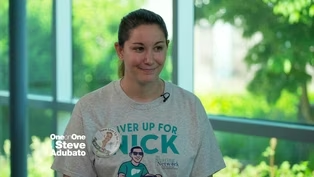
NewLiving organ donor shares her brother's lifesaving legacy
Video has Closed Captions
Clip: S2026 Ep2951 | 9m 47s | Living organ donor shares her brother's lifesaving legacy (9m 47s)
 New
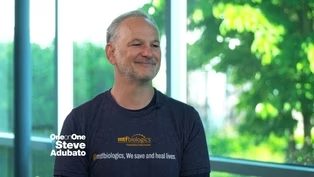
NewPresident & CEO of MTF Biologics describes tissue donation
Video has Closed Captions
Clip: S2026 Ep2951 | 8m 6s | President & CEO of MTF Biologics describes tissue donation (8m 6s)
Providing Support for PBS.org
Learn Moreabout PBS online sponsorship New Episode
- News and Public Affairs

Top journalists deliver compelling original analysis of the hour's headlines.
 New Episode
- News and Public Affairs

Today's top journalists discuss Washington's current political events and public affairs.
 New Episode
 New Episode
 New Episode
 New Episode
 New Episode
 New Episode
 New Episode
 New Episode
 New Episode
Support for PBS provided by:
One-on-One is a local public television program presented by NJ PBS