State of the Arts
State of the Arts: June 2026
Season 44 Episode 9 | 27m 15sVideo has Closed Captions
John F. Peto, People & Stories, & Princeton University Art Museum's conservation studios.
The trompe l’oeil ("fool the eye") painter John F. Peto's legacy is revived, in part by the restoration of his Island Heights home and studio. People & Stories/Gente y Cuentos uses literature to build community and broaden perspectives. And, at the Princeton University Art Museum, visitors are invited behind the scenes to explore the often hidden work of art conservation.
Problems playing video? | Closed Captioning Feedback
Problems playing video? | Closed Captioning Feedback
State of the Arts is a local public television program presented by NJ PBS
State of the Arts
State of the Arts: June 2026
Season 44 Episode 9 | 27m 15sVideo has Closed Captions
The trompe l’oeil ("fool the eye") painter John F. Peto's legacy is revived, in part by the restoration of his Island Heights home and studio. People & Stories/Gente y Cuentos uses literature to build community and broaden perspectives. And, at the Princeton University Art Museum, visitors are invited behind the scenes to explore the often hidden work of art conservation.
Problems playing video? | Closed Captioning Feedback
Where to Watch State of the Arts
State of the Arts is available to stream on pbs.org and the PBS app.
Providing Support for PBS.org
Learn Moreabout PBS online sponsorshipNarrator: The trompe l'oeil or "fool the eye" painter John F. Peto had been forgotten, his home left to decay and his story nearly lost to history.
But now his Island Heights home and studio has been restored, as well as his legacy.
Bower: If we have the painting, I try to put the objects with the painting so people can see how he might have put together his compositions.
Narrator: Across New Jersey, People & Stories is building community through the written word.
Participants come together through the art of literature.
Leary: Literature is our birthright, and everyone should have equal access to it.
We all want to be seen, heard, and understood, and this is an amazing format for that.
Narrator: And at the Princeton University Art Museum, the conservation studios are now open to the public, showing the usually hidden work that keeps art alive.
Devolder: Just seeing a painting that's unframed laying on a table, you could tell, like, people are not used to that, and that's enough to kind of get them hooked.
Narrator: "State of the Arts," going on location with the most creative people in New Jersey.
Announcer: The New Jersey State Council on the Arts, encouraging excellence and public engagement in the arts since 1966, is proud to co-produce "State of the Arts" with Stockton University.
Additional support is provided by these friends of "State of the Arts."
[ Music plays ] Narrator: Island Heights on the Toms River near the Jersey shore is on the National Register of Historic Sites.
This is due in no small part to the presence of the John F. Peto Studio Museum.
Peto was an important 19th century artist, although he was long overlooked.
Bower: My name is Harry Bower.
I'm the curator of art and artifacts for the John F. Peto Studio Museum in Island Heights, New Jersey.
What I like about the Peto paintings also, all the pipe paintings that I've seen where there's a pipe, there's hot embers.
Peto was known for what's called trompe l'oeil, and trompe l'oeil means to fool your eye.
Kusserow: And to fool the eye in still life painting was to make images that were so realistic that you could mistake them for the real thing.
Bower: We now have 27 paintings in our collection, probably the largest collection of Peto paintings.
Narrator: Harry Bower is also an artist.
A retired art teacher, he weaves upcycled materials into kimonos, baskets, and other objects of beauty.
Bower: Peto uses everyday objects.
I think that might be the connection with Peto.
Narrator: Harry lives just a short walk away, and he's been dedicated to the Peto Studio Museum almost since its very beginnings in 2005.
Bower: We are part of the Historic Artists Homes and Studios, which is a national organization.
We're the only one in New Jersey.
Some of the other artists' homes and studios would be Georgia O'Keeffe's Home and Studio, Wyeth's home and studio.
Narrator: After Peto's death in 1907, his family continued to live in the house for almost a century, often renting rooms to seaside visitors.
But by 2005, the house had been empty for years.
Bower: I remember somebody telling me that this was the scary house when they were kids because of, you know, it got -- it fell into bad shape and repair.
Narrator: In 2005, philanthropists saved it from the wrecking ball.
Peto's heirs had kept almost all his furnishings and still life objects, which now form the core of the John F. Peto Studio Museum's collection.
Bower: They went through 60 samples of scrapings of paints to find the original colors, the historical colors of the house, and through photographs they were able to put the house back to when Peto actually did live here.
[ Music plays ] Peto is actually originally from Philadelphia.
Narrator: In fact, his father was the city's first fire chief.
Peto painted this portrait, now in the collection of the Pennsylvania Academy of Fine Arts.
It's also where Peto studied for a year.
Bower: But he came to Island Heights to play the cornet for the Methodist camp meeting grounds.
He got paid to play the cornet for the camp meeting grounds.
[ Music plays ] He gave private art lessons, also sold to tourists.
The Methodists would probably walk past his house to go to the camp meeting grounds, and he would sell his artwork to them.
[ Music plays ] Kusserow: Peto's work was very much in the shadows for the early part of the 20th century.
It wasn't until about 1950 that an art critic and historian from San Francisco named Alfred Frankenstein discovered his work and realized that he was in obscurity, in part because many of his greatest works were actually thought to be the work of another artist.
Narrator: Many of Peto's paintings were passed off as the work of William Harnett, a much more famous artist whose work sold for much higher prices.
Bower: William Harnett and Peto were actually friends, and Harnett also was a trompe l'oeil artist.
Harnett was being much more successful than Peto.
Peto stayed here in Island Heights, dedicated to his family, to his daughter, to his aunts.
Someone was putting Harnett's signature on top of Peto's paintings, because they could buy the paintings here in Island Heights or in Philadelphia.
And by the time they got to New York, they had Harnett's name on them.
Princeton Museum has one.
Kusserow: You could literally see the faded Peto signature underneath the superimposed Harnett signature.
Also, people, as they got to know the work of the two artists better, could see that there were, in fact, stylistic differences between the two.
Harnett painted new, shiny things in a very slick way, and Peto painted older things that were worn and had a sense of personality and life lived about them.
And then finally it was discovered that some of the props in Peto paintings were actually later found to be in his home and, thus, highly unlikely that they were the work of Harnett.
Bower: If we have the painting, I try to put the objects with the painting so people can see how he might have put together his compositions.
We have the ladle that's in this composition.
Visitor: Wow.
Bower: And I think, again, it's that table that's down in the studio, the tray that -- He really was dealing with everyday, common man objects.
He did quite a few paintings of a good book, a good pipe, and a good mug of beer.
Narrator: In 1983, a solo exhibition at the National Gallery of Art in Washington, D.C., catapulted Peto to his rightful position in American art.
"An American master comes into his own," declared the New York Times, and artists took note.
Bower: Jasper Johns gives Peto credit for inspiring him to do his paintings of everyday objects.
Wayne Thiebaud was inspired by Peto, again, everyday objects.
Thiebaud's collection of, like, cake paintings, another example of how he was -- he even mentions it in his book that he was influenced by Peto.
Narrator: Today, Peto's work can be found in major museums throughout the world.
Kusserow: Peto's work is lovely, wonderful to look at, beautifully composed.
His palette is rich and highly colorful.
He was a very good painter and sort of an artist's artist in that if you look at the way the paint is laid down on the canvas, it's done so in a really compelling, almost idiosyncratic way.
Bower: I just feel honored to be able to be part of Peto's legacy.
But I know he feels good about what's going on here.
[ Speaking indistinctly ] Narrator: Up next, communities of all kinds are connecting through the written word.
Leary: "Abalone, Abalone, Abalone.
At noontime, I used to go to his front porch and look at his collection of abalone shells.
I had often seen him sit for hours on Sundays, polishing each one of the shells with the greatest of care."
Why would anyone spend so long doing that?
Participant: Dedication.
Leary: Dedication?
Why else?
Participant: That's his own personal experience.
I think maybe that there's -- there's some type of inner value that this young man starts to see when he's washing off the abalone shells.
I think that that's what the whole point comes down to.
You have to seek out wisdom and the beauty of -- that you find in this world, and you know what?
And take it, grasp it, and hold on to it.
Leary: People & Stories is a program that brings people together from all walks of life, with the goal of helping to improve literacy outcomes, to connect people from many different backgrounds in our shared human experience, and community building.
I think it just really engages some deep part of us.
It's a shared live experience that just exists in that moment together.
Thankfully, this neighbor is kind to him, but like I said, he won't give him all the answers.
And some of you explain, like, he doesn't owe it to him, but does that make him a good teacher or mentor?
Lampert-Rudman: We serve a wide variety of communities -- those who are incarcerated, those experiencing homelessness, those in transitional housing, those in reentry, seniors at senior centers, and public libraries.
The ethos is getting people to bring themselves and look at themselves differently through literature.
Our programs are generally eight weeks.
They receive a story.
It's very nondescript.
All they see is the title and the author's name.
Most of our 300-plus stories in our bibliography are in the public domain.
They listen to the coordinator read this story.
They're usually no more than 10 minutes.
They are line numbered every five lines, so that the coordinator who's reading the story can bring people back to the story for reference.
Leary: But it's in the eye of the beholder, right, that we just came back to.
The top of page 32, the narrator says, "Why, I thought this collecting hobby of abalone shells was a simple affair."
Lampert-Rudman: At the end of the 90-minute session, people now have different opinions, beliefs, ideas about the people that they were in the room with.
Participant: Now, to me, that's what education is.
It's not that formal thing, necessarily.
Participant #2: It doesn't stop.
Participant: She taught me something today.
Luciano: What?
Participant: "Coqui!"
Luciano: Oh, coqui.
Participant: "Coqui!"
Luciano: The Puerto Rican little toad from -- that sings at night.
"Coqui."
Smith: This is the Crossing Borders group.
Working with seniors is different than working with anyone, because they bring all this life experience.
But you get a chance to meet people from different backgrounds.
A lot of times, you don't even realize that people from different backgrounds are exactly like you.
And that's what the people here keep saying.
"I didn't know that you thought that way.
Participant #3: I definitely agree.
As a society, we have to get to the point where we acknowledge that those lived experiences are worth something.
Where you're going to do most of your learning is when you're in the outside world actually in practice.
Luciano: When you're a certain age, and you live alone, and your family's away, this is something to look forward to.
We all come from different backgrounds, and everybody gives their feedback on their perspective, in terms of their culture, their socio economic upbringing.
And that is so wonderful.
He had his business as a shoemaker, and a lot of cultures started that way.
And he wanted a better life with his -- for his daughter because of what he went through.
A lot of men from Puerto Rico came over in the '40s.
Schwartz: We learn a lot about each other.
What's nice is that everybody has a say.
Could be different from you.
And then I would say what really personifies the group is their ability to be flexible and to accept other ideas.
That's an interesting answer.
I would never have dreamed anyone would say that, because for me, it's like a really flagrant description of prejudice.
Lampert-Rudman: People & Stories started in 1972 with our founder, Sarah Hirschman, who was a woman who loved literature.
She loved traveling.
Originally, it was in Spanish.
She looked for stories that are complete in and of themselves, and they leave more questions than answers at the end.
She was inspired by an educator, Paulo Freire, and his belief and her belief was that people learn in all different ways.
Smith: So, what do we think about that?
Is education just books, or can it be other things?
Lampert-Rudman: We don't sit there and say, well, now we're going to discuss the poetics of this story, and now we're going to discuss where the tensions were in this.
It just comes naturally.
Smith: Why does he give him two years?
Why do you think he says wait for two years?
Lampert-Rudman: We're not trying to teach them anything.
We want them to bring themselves to it, bring their own questions to it, and then get what they need from it.
Pygum: At the time I went to school, I never even heard of stories like this.
You don't really know about the story until you talk about it, and you get to hear different opinions.
You never know what you can learn from just talking.
You get to share things that maybe can change people minds about things, the way they go about things.
Leary: Did any of you have a teacher like this who taught you by kind of throwing you in the deep end?
Someone that just -- They weren't going to do it for you, and they didn't use a lot of words.
Pygum: I teach with care.
Leary: What does that mean to you?
Pygum: I just don't want nobody to know things on they own.
Knowledge is free.
Leary: Okay.
Pygum: All that is free.
It's just, some people don't want to give it to you.
Leary: At the end of our eight weeks, they've earned a certificate from the program.
And why that can be important, especially in a place like The Father Center, is, most of these men are trying to find sustainable employment and are doing applications and interviews daily.
And so this is just one more tool for them to include in their portfolio with their résumé.
Saiz: Today was a different day, because we never had a writer.
So it was very special.
She did a great job connecting with the group.
Mendez-Booth: So, I brought a few short pieces.
that are meant to be performed.
I don't usually do my work in Spanish, so it was wonderful to have that participation with the group.
So it became more of a sharing.
Smith: Everybody has a story to tell, and every story resonates some part of your life.
Leary: Literature is our birthright, and everyone should have equal access to it.
I think we are all starved for connection, in-person, human connection.
We all want to be seen, heard, and understood, and this is an amazing format for that.
Really listening and being open minded to someone else's point of view and walking away a little bit different in your convictions than maybe you came in the room would be hugely valuable for all of us.
Saiz: We are all waiting to be heard, to be listened to, and we are all waiting to listen to others, to tell us their own stories.
Narrator: Last on the show, the hidden art of conservation is brought to light.
[ Music plays ] Princeton University Art Museum reopened in October 2025 as a stunning new building filled with grand spaces and over 30 galleries.
Included in Time magazine's World's Greatest Places of 2026, the expanded museum now exhibits more of Princeton University's deep art collection.
Open to the public with free admission, Princeton is a teaching museum, and carving out studio space for its conservators is part of that mission.
Devolder: When the museum opened, it was very exciting also for conservation, because finally, we had designated spaces for conservation.
Conservation is no longer, you know, we do this in the back room, and then all of a sudden, it comes out, and it looks pretty again.
We want to take people on that journey.
We want to show what we do.
Narrator: Conservators work with curators and others to ensure that paintings and 3D objects in the collection are carefully preserved, whether they're on display or in storage.
They examine new acquisitions and collection pieces coming out for display for any damage or deterioration, and then assess whether any hands-on restoration or minor maintenance is needed.
Torok: All conservators need to have a strong foundation in studio art, art history, and chemistry.
Devolder: How materials interact with one another, whether it's to clean a painting or to glue something back together.
Art history -- We need to know where this artist sits in the bigger scheme of art history.
And then, there is the kind of manual skill set that one has to have.
Narrator: Traditionally, this steady flow of analysis and meticulous work is done behind the scenes, even off-site.
The conservation studios show that work, and now a monthly open house brings visitors in.
Devolder: Just seeing a painting that's unframed laying on a table, you could tell, like, people are not used to that, and that's enough to kind of get them hooked.
Torok: We are able to speak with our visitors and answer questions and show different projects that are ongoing in the studios, talk about materials and techniques and different tools and equipment that we use, too.
It fits really well within the framework of a teaching museum.
Devolder: So this little painting here, for example, I did a little cleaning test here.
So that's where I removed part of the yellow varnish on it.
So, when an artist makes a painting, very often, they apply varnish to saturate the colors, but also to protect the layers.
And that layer tends to yellow.
And that yellow layer kind of puts a veil on the whole surface, which means we can no longer see what the artist originally intended.
And so it is then our job to very carefully remove these varnishes.
We try small parts of the painting until half the painting's finished.
Then we have photographs taken.
We document every step, and then we'll apply new varnish, and the painting can go on.
Everything that we do to a painting needs to be easy to undo.
What we add needs to be un-doable in the future, meaning reversibility is the key concept.
80% of what I do is undoing what my colleagues did, mostly with the knowledge they had, with best intentions.
But there's a lot of new science.
What we do needs to be very easy to be undone by future generation of restorers.
When we are asked to look at something, we kind of use our eyes, but we also have a whole lot of toys that we can use.
So this is an infrared reflectography camera.
It allows us to see through the paint layers.
So it shows the actual underdrawing.
It's super important, because an underdrawing is a little bit like a signature.
By examining the underdrawing, we can see that this painting was made in the studio of the artist and very likely by an assistant.
They used a template that was pre-pricked little holes, and the assistant just had to literally connect the dots.
And none of that you can see on the painting.
There were probably 50 if not 100 of these.
This way, you could have this consistency throughout the whole studio approach, even in the 15th and early 16th century.
Torok: When visitors are in the galleries, we want them to see a work of art in the way that the artist intended it to look, without focusing on an area of damage.
I will finish and sand and smooth, applying a white fill material that is reversible later if needed, before I then put some color down that will match surroundings.
So when you look at it in the gallery, you won't be able to see the loss anymore.
Patience is a really important part of what we do.
Some days you might spend working on the same square centimeter under a microscope.
Not every project is that way, but some of them are.
When the museum was closed for about five years, approximately 300 objects came through the studios in need of some kind of conservation treatment.
Some of those objects, including our Mallorcan Gallery and Stair, including many of the mosaics that are now under the glass floors, had preexisting conservation issues that the museum was never able to address, because they were permanently embedded in the buildings.
We had an entire network of help to do that, external conservators and other specialists.
Being able to be part of these bigger treatment projects was amazing.
It's been a total honor to be part of the team at this particular moment in the museum's history.
And the great part of being at Princeton and having a studio that's visible to the public is that we're able to share more of what we do.
Narrator: Conservators see art objects in ways that are invisible to most of us.
In an installation called Backstories, Bart Devolder shares his unique perspective by hanging paintings with their faces to the wall.
Devolder: This one's painted on a mahogany cabinet door.
This one's painted on a pine shingle from a roof or the side of a house.
Here, it's like, oh, this is kind of peculiar.
Why are these paintings hung the wrong way?
And this one's painted on a cigar box lid.
It's important for people to see that a painting is more than an image in a book.
It's a 3D thing, right?
It has a structure.
It's painted on top of something.
And I think people will be surprised how much information you can gain from just looking at the back of something.
Object-based teaching is something we take very seriously.
And what is more object-based teaching than, like, virtually taking the piece apart?
In order for us to do our job as in preserving it or restoring it, we need to understand how it's made.
"Portrait of a Donor" by Moroni, Italian 16th century painter, we discovered a fragment of an open book that was previously painted out, but also a floating shoe in the midst of a sky.
That led us then to a whole new avenue of research.
Because a similar shoe was found on a painting that's currently in Virginia, we now know what the other part of the painting is.
So we know something's missing here.
What makes this then different is what do we do as a restorer or conservator?
Are we showing the story of this cutting a painting in two, which was possibly done by a dealer so they could sell two paintings instead of one, or are we hiding all that?
And that's exactly what the previous restorer did in the late 1960s.
We ended up showing this damage.
The story and the damage is more interesting than hiding it in this case.
And that is something in a teaching museum like Princeton University Art Museum, we can tell stories like that.
That's what we do.
That's exactly why we're here.
Narrator: That's it for this episode of "State of the Arts."
To watch more stories or to leave a comment, visit stateoftheartsnj.com.
Thanks for watching.
[ Music plays ] [ Music plays ] [ Music plays ] [ Music plays ] [ Music plays ]
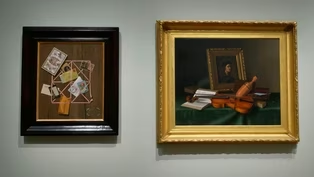
An Artist's Journey from Obscurity to Fame: The John F. Peto Studio Museum
Video has Closed Captions
Clip: S44 Ep9 | 7m 30s | Forgotten in life, John F. Peto's legacy is revived through the restoration of his home. (7m 30s)
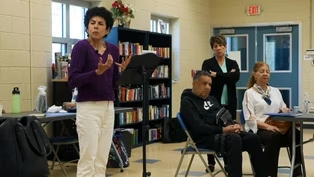
Video has Closed Captions
Clip: S44 Ep9 | 8m 39s | People & Stories / Gente y Cuentos uses literature to foster connection and community. (8m 39s)
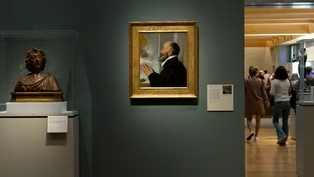
Showing the Work: The Conservation Studios at the Princeton University Art Museum
Video has Closed Captions
Clip: S44 Ep9 | 7m 54s | Princeton University Art Museum opens its conservation studios to the public. (7m 54s)
Providing Support for PBS.org
Learn Moreabout PBS online sponsorship New Episode
- Arts and Music

Innovative musicians from every genre perform live in the longest-running music series.








 New Episode
 New Episode

Support for PBS provided by:
State of the Arts is a local public television program presented by NJ PBS