State of the Arts
State of the Arts: Rhythm & Roots
Season 44 Episode 7 | 27m 16sVideo has Closed Captions
New Jersey Heritage Fellows: Alessandra Belloni, Tyrese Gould Jacinto, and Neelima Raju.
New Jersey Heritage Fellowships honor artists who preserve cultural traditions. On this special episode, meet three fellows whose work is deeply rooted in ancestral practice and shared experience: Alessandra Belloni, performer and teacher of the ancient healing dance Tarantella; Tyrese Gould Jacinto, Indigenous artist and author, and Neelima Raju, a master of classical Indian Kuchipudi dance.
Problems playing video? | Closed Captioning Feedback
Problems playing video? | Closed Captioning Feedback
State of the Arts is a local public television program presented by NJ PBS
State of the Arts
State of the Arts: Rhythm & Roots
Season 44 Episode 7 | 27m 16sVideo has Closed Captions
New Jersey Heritage Fellowships honor artists who preserve cultural traditions. On this special episode, meet three fellows whose work is deeply rooted in ancestral practice and shared experience: Alessandra Belloni, performer and teacher of the ancient healing dance Tarantella; Tyrese Gould Jacinto, Indigenous artist and author, and Neelima Raju, a master of classical Indian Kuchipudi dance.
Problems playing video? | Closed Captioning Feedback
How to Watch State of the Arts
State of the Arts is available to stream on pbs.org and the free PBS App, available on iPhone, Apple TV, Android TV, Android smartphones, Amazon Fire TV, Amazon Fire Tablet, Roku, Samsung Smart TV, and Vizio.
Providing Support for PBS.org
Learn Moreabout PBS online sponsorshipNarrator: On "Rhythm and Roots," a special episode of "State of the Arts," meet three New Jersey Heritage Fellows, artists whose work is deeply rooted in ancestral traditions carried across generations.
Alessandra Belloni teaches ancient southern Italian music and dances, including Tarantella, an art of movement and healing.
The dance's trance-like rhythms allow the cathartic release of emotions and energies.
Belloni: These devotional movements actually move your energy and release blockages, especially for women.
That's how these were created -- for healing.
[ Drumming and singing ] Narrator: For Tyrese "Bright Flower" Gould Jacinto of the Nanticoke Lenni-Lenape nation, art is not separate from life.
It's something you live.
Through connection to the earth, the daily act of creation serves as a dialogue between generations.
Jacinto: The community itself allows for everybody to learn from each other.
So it's really not something that we say, "Oh, will we pass this down?"
It's just something that we live with.
[ Vocalizing ] Narrator: In 1947, after 200 years of British rule, India began to reclaim its identity by reviving its traditional art forms, including Kuchipudi dance.
Once performed only by men, today, women are masters of this southern classical tradition as well.
In New Jersey, Neelima Raju inspires her students to connect to their culture.
Raju: As an artist, whatever the form you're doing, you have to tell a story.
If you want to become that artist, you have to really touch that vein in a human being.
It has to communicate something with the body.
Narrator: On this special episode, "State of the Arts" goes on location with New Jersey Masters of Traditional Art.
[ Lively music plays ] Announcer: The New Jersey State Council on the Arts, encouraging excellence and engagement in the arts since 1966, is proud to co-produce "State of the Arts" with Stockton University.
[ Music plays ] Belloni: In America, people think of Italian music, most people think of Neapolitan classical songs.
But that's not what we do.
That's not what I do.
So our first goal is educate Italian Americans here on their musical ethnic background and then teach it to the new generations.
[ Music plays ] The devotional dancing and the music is ancestral, so it goes back thousands of years.
These devotional movements actually move your energy.
So they really touch in different chakras and move the energy and release blockages, especially for women.
So release sadness, anguish, fear.
And then the chanting we sing so loud, you know, so from the throat, opens your throat chakra.
So all these energy points release blockages without thinking about it.
That's how these were created -- for healing.
Beautiful group.
[ Clapping ] I'm Alessandra Belloni and we are at the Cathedral of Saint John the Divine.
I am from Rome.
I grew up actually in a family where we didn't really go to church that much.
But coming here, I really understood what a church is supposed to do in order to help humanity and also social work and activism.
I started out as a singer and an actress as a child.
In 1977, I heard this folk music being played by a great group from Naples called La Nuova Compagnia di Canto Popolare.
And I said, this is my heart and soul.
So I started to learn how to play the tambourine, how to dance these intricate folk dances that have a general name, the Tarantella or Tammurriata.
But in the beginning, I was really young, early 20s.
I did not know the tradition.
And like any indigenous culture, to learn, you have to go on the field, learn from the old people.
[ Music plays ] If you really want to do it seriously, you can spend your life in it, dive into it and with the people from the places.
So I went to all over, to, besides my region of Rome, Naples, Campania, Calabria, Puglia, and Sicily.
Travel everywhere.
In Italian, the term is "rubare con gli occhi" -- you steal with your eyes.
And then it was a point where it clicked.
I could say I became a master of the tambourine technique of the tarantella.
And it took about ten years at least.
[ Playing tambourine ] I also met a guitarist and composer here in New York, John La Barbera, in 1979 or early 1980.
We're now celebrating 45 years.
We started our group called I Giullari di Piazza, the players of the square.
[ Music plays ] We're singers, actors, musicians, dancers, people who dance on stilts.
And it's not just entertainment, you know.
It's like a ritual experience for the audience.
[ Music plays ] Posey: I feel like what's important about this dance and this music is it brings people together and it takes us away from the individualistic into the collective.
This is such a welcoming movement.
There's a lot to be said for moving together.
That creates a powerful space for people to connect and grow.
Belloni: Just like the spiders do.
During my workshops, I also teach the dance for the Black Madonna and the drumming for the Black Madonna, which is called Tammurriata, from the region of Naples, Campania.
I'm very devoted to the Black Madonna.
[ Music plays ] She is a Christian devotion.
The truth is that she is also pre-Christian tradition.
In one word, she's the pre-Christian tradition of the goddess of the earth.
[ Music plays ] Culturally, the Black Madonna also represents the African mother, the cradle of humanity, where we come from.
The face changes.
The eyes look at you.
But each person will have a personal experience with her.
And I think that's very powerful.
Thousands of people, every year on the same day, worship the Black Madonna like they did in pre-Christian times with drumming, singing, and dancing.
And chanting and chanting.
[ Chanting ] [ All chanting ] [ Rhythmic music and singing ] -So the way people did healing in the Middle Ages and even before was honoring the Madonna, the Saints, drumming, dancing, and doing these prayers in a trance.
The 6/8 obsessive rhythm or 12/8 is a trance rhythm all over the world.
Originally African, everyone agrees on that.
[ Playing tambourines ] It was for the purpose of putting people in a trance for shamanic purposes so that you can receive the healing or the vision.
It starts spinning, spinning, and spinning and spinning.
That creates a trance.
And when I do in a workshop, the purpose is to let go of your ego, and receive the vision from above, and heal whatever you want to heal.
I want people really to experience what that does to your body, that 6/8 [vocalizing] before you dance.
The original Tarantella, Pizzica, means "bite."
Tarantata is the name of a woman afflicted by the bite of the tarantula, which is the original Tarantella done to cure from the mythical bite of the tarantula, which is a metaphor for a form of depression known as Tarantismo that afflicted mainly women, especially in Puglia, but was all over southern Italy.
And many times the women suffered this kind of sadness and depression where women were abused.
So there is a connection with that dance to heal from trauma.
[ Music plays ] Today, here where I live in America and other parts of the world, people are ready to receive something that is real and authentic.
We live with incredible stress, and we live in a society that is not just at all.
I really hope to leave a legacy.
It's a very difficult art form.
It's not commercial.
It's not, you know, I'm not a rock star, obviously.
So I chose to do something non-commercial for devotion, but I wanted to transfer it to other people, to young people and leave a legacy.
That's exactly where I am now.
[ Music plays ] [ Music plays ] [ Music plays ] Narrator: Art keeps culture alive.
Next, in South Jersey, members of the Lenni-Lenape Nanticoke Tribal Nation use traditions to create community.
[ Music plays ] Jacinto: For me, art is everyday life.
Everything we do in life is art.
Getting dressed in the morning is art.
We are living in art.
And if we don't realize that everything we do is art, then we don't have a creative process.
We're looking for somebody else to create our world for us.
Everything we do is an individual piece.
As the Creator makes us different, we also make our pieces different.
But it also has to be a useful item.
And it's a little different in the art world because they make art just for the wall.
To us, art is in the usefulness as well.
I feel like I'm an empty vessel of what the Creator has to say.
If I empty my mind and I meditate, then I'm open to what the Creator has for me.
It just pours out.
And that's where the creation comes from.
But I used a lot more colors than necessary.
Well, my name is Tyrese Gould Jacinto, also known as Bright Flower, and I am an artist.
I am from the Nanticoke Lenni-lenape Nation here in South Jersey.
I really don't put a lot of emphasis on the nomenclature of colonization of what they call us.
You know, just call me Ty, because I really don't want any labels, any names or anything.
The Creator made us this way.
But if you take away all the onion skin layers and you just realize that we're just a family, we're just a family.
And when you spend time with family, you want to do activities.
These are our things that we do.
[ Drumming and singing ] I try to bridge the past to the present.
Because we're still here.
So when you live with something on a day-to-day basis, one of the things that's really indicative of our people is making something from nature.
When we have our community festivals and there's multiple generations, you'll have from great-grandparents all the way down to newborn babies, always in the same room interacting.
The community itself allows for everybody to learn from each other.
So it's really not something that we say.
"Oh, well, we pass this down."
It's just something that we live with.
[ Singing continues ] -Our Cohanzick Nature Reserve, we purchased because we needed to expand.
We're a conservation organization.
So right now we do a lot of conservation work with the state of New Jersey DEP and so forth.
It's 63 acres of clear trails.
And the trail system has been there since pre-European incursion.
This property was once where my great-grandmother was born and lived and all our families.
In my grandmother's book, she said, this is the dust of my ancestors, and one day will be the dust of me.
And this property has never been clear-cut.
It has the same soil complexity from the Ice Age.
[ Music plays ] Saunders: Music brings people together.
The belts are artwork, the pine needle baskets are artwork.
It shows pride.
It shows that we reuse what's around us.
We make things that are practical out of things that people throw away.
[ Music plays ] [ Chanting ] We're here to share culture.
We're here to share our lives, to make people aware.
[ Chanting continues ] [ Music plays ] -On our ranch, we are what's considered the new word permaculture.
So we recycle the manure and use it for fertilizer.
We don't use any pesticides.
We have dogs that help us with herding.
We have alpacas that we use for the fibers, mainly to stuff the little dolls that I make.
The Lenape dolls.
The no-face dolls.
This was made for my granddaughter and it's made after one of my stories, also, called "The Wishing Doll."
It's made out of all leather and eventually she'll get moccasins.
Homemade moccasins and leggings.
[ Music plays ] There's so many art practices.
But I did bead work first, and I was eight years old when I learned bead work.
And I really like gourd work, because those seeds have been passed down through the gourd for thousands of years.
And then when I plant that seed into the soil, it's the dust of my ancestors.
[ Music plays ] This is the first stage.
This is planting the seed.
I got some of the seeds from my grandmother's collection.
So here is where I dry the gourds.
So I could make something out of this one.
This is actually like considered a hard wood now.
And just think, people have done this for 10,000 years.
Or more, probably.
This is absolutely gorgeous.
The perfect imperfections.
It doesn't need much.
Sometimes it'll take me all day.
[ Music plays ] This is an idea that I came up with.
It's called "It Takes a Community" and this is the grandmother, and these are all the children of the community and she is keeping them company.
Underneath her dress, there's actually a dream catcher.
And she is the keeper of all the children.
You know, I've always been a storyteller, and there were no native books and my children didn't grow up with any native books.
I'm like, "Well, I just have to fix it."
"We can only curse ourselves with bad wishes, but we can bless others through our good wishes.
Now all we say is, I wish you peace.
I wish you peace and prosperity, and may all your wishes come true."
When we thought about the symposium, it just kept growing.
We had demonstrators, we had food, we had dancing, and we had guest speakers.
But the symposium was a little different because we allowed the audience to ask questions in between, after each presentation.
It was a whole combination of all of us together, the experts that have studied in these fields, and the people that live it.
Cooper: The aunties showed up today.
They showed up today and I actually learned a lot from them today.
I learned a lot from my mom already.
She passed down gourd art, pine needles, corn husk dolls, many, many things.
But what she passed down, there are other versions of it which I rarely have seen, so I'm looking at their art, the aunties across the hall, and I'm seeing there's other ways to do it.
I'm glad that I have this stuff passed down to me because I have three kids and it's being passed down to them also.
Sernak: The symposium is bringing together arts, music, food, the sense of community.
We're bringing all that back in and we're sharing the resources from our traditions and our ancestors to help us move forward with more of the current traditions and times, especially for our youth.
It's really important for them to see it.
[ Drumming continues ] Jacinto: This symposium was very key because it was not just experts about us.
It combined us as a part of the narrative.
We opened up the door to bridge that past to the present to rewrite the narrative.
Because all the books speak of us is in the past tense.
"They used to," "They were," And "This is what they did."
And it brought it to, well, this is what we do.
This is how we are.
And this is what we still do.
[ Drumming and chanting continue ] Narrator: Last on the show -- The ancient classical Indian dance form of Kuchipudi is alive and well in New Jersey.
[ Music plays ] [ Music plays ] Raju: Kuchipudi was originally a drama tradition and also it was not performed inside the temple.
It was performed on the outside.
So it has elements of rhythm, movement, gesture, and mime.
[ Music plays ] [ Vocalizing ] As an artist, whatever the form you're doing, you have to tell a story.
It has to communicate something with the body.
You may not understand the words, but you have to feel the emotion.
[ Music plays ] If you want to become that artist, you have to really touch that vein in a human being.
So if it is about love, it's trying to make somebody feel about their own personal experience.
And if it is really about estrangement or pain, everybody has these things.
You know, we are all human.
[ Music plays ] There's no formula.
It's not about technique.
It's also about learning to communicate with that technique and tell that story.
[ Music plays ] I'm Neelima Raju.
I'm a Kuchipudi performer and I'm also Kuchipudi teacher and I live in Edison.
I started this art form in 1987.
I went to one traditional guru who was from the village of Kuchipudi, and that's how I started my journey.
And in 2001, I came to this country for a higher degree.
But that was in science, and I pursued my art form simultaneously.
I was performing back in India, and I continued my performances here as well as I started my teaching and then passing the art form to the next generation.
So this is the journey so far.
[ Music plays ] Let's start with a small prayer.
You guys are ready?
[ Praying in global language ] Raju: One, two... [ Vocalizing ] Next.
[ Vocalizing ] Indupriya: I started when I was three and a half years old and for a long amount of time I just watched.
Fundamentals, you would basically think of them as like ABCs.
Instead of actual alphabets, it's like small footwork, foot movements, and hand gestures and then small building blocks or ABCs.
And then you put them together and make sentences like [ Speaking global language ] Gopichand: You are immersing yourself into something that is more than a dance.
So it is the metaphysical piece of it.
Like you are kind of meditating.
Kasturi: It's just not the dance form.
You really develop a kind of discipline and real life skills.
[ Singing ] Gopichand: We are passing it on.
So like everything, it's part of the culture, tradition.
Staying close to home a little bit, adding a flavor in American melting pot, if you will.
[ Music plays ] -So dance has been in India for quite some time.
Music and dance is in the Natya Shastra, so that is the oldest book which we all go back to.
And from there, we have the regional variations of the dance form.
It comes from the root word Kuchila means it's a broken house.
It was all males.
And they would also do not just the dance, they would also practice literature.
This continued 'til the post-Independence era.
And then there was a nationalist sentiment after the British left and everybody was searching for an identity, a unique identity for the southeast part of the country.
[ Applause ] Then a few traditional gurus came up and they structured everything.
And that's how it got recognized as Kuchipudi.
And with it came the introduction of women, because it became a more free society.
And just like women have come out of their homes to do a lot of other things.
And that's how we also learnt.
[ Music plays ] So you have the notes of music and you have rhythms.
The most important factor of interpretive dance is using your face to communicate ideas, to communicate the meaning of the poetry.
You have three modes of interpretation in Kuchipudi.
The first one is called Padartha.
It's a literal meaning.
For instance, if you want to call somebody like your beloved or something, then you -- you just say, "Swami rara," meaning, "My beloved, come here."
Vadyata is the meaning of the sentence.
The emotive meaning.
So when she's calling her beloved, obviously she won't be angry.
So she's basically going to say, "Swami, rara."
Then you have Sancharis, which are metaphors and similes, the one with the beautiful eyes.
You are so great and you are so nice.
Why don't you come here?
So this is all within that framework.
You can explore different things, keeping the poem in mind.
There is a large population of Indians in Edison.
So in terms of culture, we do have a lot of people, but it's all over from India.
So it's not just from my place.
My students do get invited and they do their cultural festivals outside.
And that is all part of learning.
And they also, you know, understand their roots much better.
The dance that Indu did today is a very traditional form of poem which is called Kavitha.
Kavitha in Telugu means poem.
[ Music plays ] The dance piece was a story about describing Ganesha and all his attributes and all his physical attributes as well.
The one with the large trunk and also describing him as the remover of obstacles.
And Ganesha -- Ganapathi basically is praying to him.
The piece that I performed is from a traditional opera.
It is an excerpt from an opera called Krishna Leela Tarangini.
The dance on the plate has a tradition where what happens is when you dance on the plate, you cannot use your space.
Automatically, the attention of the audience falls on the rhythm.
It's not for mere showmanship.
It's adding to the visual element of that poem.
The art form has to be definitely passed on from one generation to the other, not just as an art form, but it also teaches children how to really develop their intuitive skill sets, their creative skill sets.
And I think they're very important not just for artists, but also for people who are doing science and math.
So many different things that shape you as an individual.
[ Music plays ] Performance is just, it's short-lived.
It's not going to be there forever, because everybody gets old, let's face it.
Whereas as an educator, you see your dance through them.
So that is the most satisfying for an educator.
After you're gone, it still lives with them.
[ Music plays ] [ Music plays ] Narrator: That's it for this special episode of "State of the Arts: Rhythm and Roots."
To find out more about these New Jersey Heritage Fellowship artists, visit StateoftheArtsNJ.com Thanks for watching.
[ Music plays ] [ Music plays ] [ Music plays ] [ Music plays ] Announcer: The New Jersey State Council on the Arts, encouraging excellence and engagement in the arts since 1966, is proud to co-produce "State of the Arts" with Stockton University.
[ Music plays ]
 New
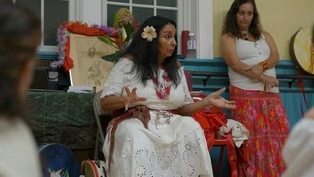
NewAlessandra Belloni: Healing Music & Movement
Video has Closed Captions
Clip: S44 Ep7 | 7m 45s | Alessandra Belloni teaches the ancient Southern Italian music and dance of the Tarantella. (7m 45s)
 New
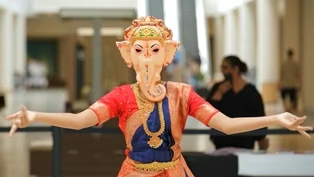
NewNeelima Raju: Connecting with Kuchipudi
Video has Closed Captions
Clip: S44 Ep7 | 7m 34s | Neelima Raju inspires students to connect with Kutchipudi, an Indian classical dance. (7m 34s)
 New
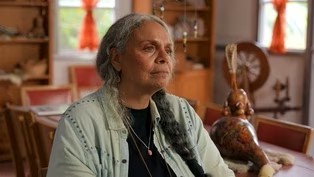
NewTyrese “Bright Flower” Gould Jacinto: Life As Art
Video has Closed Captions
Clip: S44 Ep7 | 7m 37s | Tyrese Gould Jacinto keeps Nanticoke Lenni-Lenape culture strong through art. (7m 37s)
Providing Support for PBS.org
Learn Moreabout PBS online sponsorship














Support for PBS provided by:
State of the Arts is a local public television program presented by NJ PBS