State of Affairs with Steve Adubato
Jim McGreevey and Elie Aoun, MD; Philip B. Alagia; Ronald Chen
Season 10 Episode 8 | 27m 59sVideo has Closed Captions
Jim McGreevey and Elie Aoun, MD; Philip B. Alagia; Ronald Chen
Jim McGreevey, Former Governor of NJ and Dr. Elie Aoun, Assistant Professor of Clinical Psychiatry at Columbia University, discusses he criminal justice system and trauma. Philip Alagia, Chief of Staff for Essex County, talks about building a government from the ground up. Ronald Chen, Distinguished Professor of Law at Rutgers Law School, breaks down federal immigration enforcement.
Problems playing video? | Closed Captioning Feedback
Problems playing video? | Closed Captioning Feedback
State of Affairs with Steve Adubato is a local public television program presented by NJ PBS
State of Affairs with Steve Adubato
Jim McGreevey and Elie Aoun, MD; Philip B. Alagia; Ronald Chen
Season 10 Episode 8 | 27m 59sVideo has Closed Captions
Jim McGreevey, Former Governor of NJ and Dr. Elie Aoun, Assistant Professor of Clinical Psychiatry at Columbia University, discusses he criminal justice system and trauma. Philip Alagia, Chief of Staff for Essex County, talks about building a government from the ground up. Ronald Chen, Distinguished Professor of Law at Rutgers Law School, breaks down federal immigration enforcement.
Problems playing video? | Closed Captioning Feedback
How to Watch State of Affairs with Steve Adubato
State of Affairs with Steve Adubato is available to stream on pbs.org and the free PBS App, available on iPhone, Apple TV, Android TV, Android smartphones, Amazon Fire TV, Amazon Fire Tablet, Roku, Samsung Smart TV, LG TV, and Vizio.
Providing Support for PBS.org
Learn Moreabout PBS online sponsorship- [Narrator] Funding for this edition of State of Affairs with Steve Adubato has been provided by PSEG Foundation.
Newark Board of Education.
Horizon Blue Cross Blue Shield of New Jersey.
The Turrell Fund, a foundation serving children.
Robert Wood Johnson Foundation.
Working to create a future where health is no longer a privilege, but a right.
NJ Transit.
Your ride to the world’s game.
New Jersey Sharing Network.
The Fund for New Jersey.
And by United Airlines.
Promotional support provided by BestofNJ.com.
All New Jersey in one place.
And by New Jersey Globe.
[INSPRATIONAL MUSIC] - Hi everyone, Steve Adubato.
We kick off the program talking about trauma, what you need to know about why it matters.
We're joined by the former governor of the great state of New Jersey, Jim McGreevey, Executive Director of the New Jersey Reentry Corporation.
And Dr.
Elie Aoun, who is in fact, Assistant Clinical Professor of Psychology at Columbia University.
Thank you both for joining us.
Governor McGreevey, we've talked about this, you actually pitched this, you called me and said, "Steve, we need to do this.
This is an important topic."
A, why?
and B, why is a doctor involved?
- So Steve, our... Our entire criminal justice system is focused on guilt or innocence, in a sense, we have a system that only understands two components, and whether it's prosecution, whether it's from indictment to adjudication, to parole and probation, guilt or innocence.
And so what you know, we do in New Jersey Reentry is we recognize that about 96 to 97% of people are gonna return back into civil society, they're gonna be your neighbors once again.
But if we do everything right in terms of providing services when they come home, whether it's you know, federal estate support, whether it's health insurance and even a job, but we don't take care of what happened from the neck up, there's a high probability, I would argue, there's a propensity that people are gonna commit a crime once again.
And so it's understanding that mental illness.
Our mutual friend, Phil Alagia said, 25 years ago when he walked through a county jail, there was a high propensity of individuals that were suffering from addiction.
We solved the addiction crisis.
But what's happening today is that the mental health crisis is exploding for any number of reasons.
Our purpose is not to grapple with the origins of the mental health crisis, but to address it.
And that's why Dr.
Aoun is here, because when people go through prison or combat trauma, they get into survival mentality, fight or flight, they no longer start thinking thoughtfully and rationally in terms of sound decisions.
And with that, Dr.
Aoun.
- Dr.
Aoun, explain also in context of what Jim McGreevey is saying.
Explain what trauma is, and put this conversation in context.
- Right.
So if you're talking about trauma, we have to separate between trauma that is clinically significant trauma that rises to the level of causing people to have mental health symptoms, mental health disorders, or trauma that affects a person's functioning on a day-to-day basis, but does not affect... Does not result in a psychiatric diagnoses or symptoms.
Both are bad, both are things that should be avoided, but one is associated with pathology, significant need for treatment, and can be associated with a person's functional status deteriorating, and that can lead to them engaging in criminal behaviors, and entering the justice system.
- Well, let's talk about entering the justice system.
Governor, you understand prisoner reentry more than most.
What goes on for most people... Many people who are in prison?
And what is the impact of the prison experience on many, as it relates to existing trauma and inflicting more trauma?
- So Steve, great question.
So, when some... When a guy's you know, surviving, whether at East Jersey Prison or Trenton, and candidly... And I can give example after example, but prisons are tough places, where the people we serve, whether they're combat veterans, whether they're former prisoners, whether people suffering from addiction.
Life is hard and filled with trauma.
And Dr.
Aoun will explain that people get into a survival mentality.
And so at the end of the day, and a great example, a good buddy of mine who was in Raleigh State Prison, somebody knocked his tray off, the guy fought almost to the death over a tray of food, and it's about survival.
And the reality is, that type of reflexive violence with the inability to think and to understand what just happened, once you go outside into the community, it doesn't work, you can't live in a civil society.
And so whether it's PTSD with our veterans, whether it's that type of trauma, as well as with our victims of domestic violence, part of it is, is cognitive behavioral thinking.
Literally working with people Steve, to help them rewire and rethink how they approach.
- In light of what the governor just said, Doctor, to what degree is the trauma that Jim McGreevey is talking about, particularly in prison, impacted by race?
There's a racial component to this, because the disproportionate number of people who are incarcerated, are people of color.
And so therefore, math just would seem to dictate that the disproportionate of people dealing with... Number of people dealing with trauma, vis-a-vis prisons, are people of color.
Is that a fact, Doctor?
- That is a fact.
The truth is, trauma affects everyone, from every race.
But people of developed ethnic minorities, or other minority groups tend to be affected by trauma... (audio cutting out) Something we call the "Minority Stress Theory", where you know, existing in society, that's stressful.
Learning how to coordinate... To live with your neighbors, to do all of those things, that's stressful.
But when your minority status itself become a stressor, that adds to your experience of social... Social Stress Theory, and that's what we call Minority... Minority Stress Theory.
When you compound that with trauma, someone who's been traumatized, someone who's been assaulted, someone who's afraid for their life, who tends to see the world as a negative place, as an unsafe place, that's a recipe for things going really poorly.
- Doc, can you just talk about the trauma cycle to Steve?
What this cycle happens, and how it actually worsens and worsens, it becomes more and more violent.
- Absolutely.
So, when... When you've been traumatized, it affects how you see the world, you... I mean, before someone's been traumatized, they see the world as a constructive, supportive place.
Your neighbors, your parents, your friends, your family, they're all there to take care of you.
And then when you've been traumatized, you learn maladaptively that the only way to take care of yourself is that it's every man or woman for themselves.
And that causes you to isolate, that causes you to regress, and think about the world as a negative, dark, dark space.
And what you do when you're in that mentality, is that rather than building and seeking supportive sources, you tend to fall back into the patterns that lead you to be more vulnerable, to being more victimized, to more trauma, to more engagement with the justice system.
- It's a cycle?
- Yes.
And it actually Steve, worsens.
I mean, I had a friend of mine who's a nun, and she goes to Trenton State, she said, "Look, if I could redesign prisons, I'd send people to convents, because what you're doing is you're taking young guys, you're throwing them into prison, where by definition it's violent, it's all about survivalist.
Nobody's talking about right or wrong in prison, they're talking about survival.
And that's what you learn, and when you come out, and somebody bumps you in the subway or on the path, what you immediately do is, it's a threat to your survival."
And so that type of mentality is what we're trying to grapple with.
- [Steve] Do we have a realistic ability to quote, "break the cycle of trauma"?
A, and B, what is the role of government in doing that?
Doctor, can we break it?
- Yeah- - Got two-minutes left.
Go ahead.
- The nice thing about when things become a vicious cycle, is that the way to break that cycle is to create kinks at any point in the cycle, we could create those kinks at the level of the government, at the level of the punishment, we can create those kinks at the level of the treatments that we're offering the person.
But it's all about extracting the person from that cycle, whether by providing them mental health services, vocational support, occupational resources, or better incarceration conditions, improving the traumatic circumstances during incarceration, that will pull the person out of that... The cycle they're in- - And Steve, if I can just jump in and just say, also judges.
Judge Cory, she, particularly with combat veterans, is doing a great job.
Basically, these combat veterans, PTSD, they've been multiple deployments, and he's bringing them in for serious crimes, having them plead guilty and saying, "All right, we're gonna work with you.
I'm giving you psychiatric attention, I want you to work with me on this road, and then we'll renegotiate your plea down the road."
But the important point of this is, judges or lawyers, it's a lot easier to send somebody to prison, than to send somebody for psychiatric treatment.
And the same way we address addiction in this country, we have to address mental health, or we're not gonna get this right.
- Jim McGreevey, a former governor, who is also the Executive Director of the New Jersey Reentry Corporation.
And Dr.
Elie Aoun, who is the Assistant Clinical Professor of Psychology at Columbia University.
Governor, every time you call and reach out, there's an important issue to explore, and you brought the doctor to us, so we say thank you.
Thank you to both of you, we will not... This will not be the last conversation we have about trauma.
Thank you, gentlemen.
- Thanks brother.
Thank you.
- You got it.
- Thank you, Doc.
- You guys stay with us, we'll be right back.
(grand music) - [Announcer] To see more State of Affairs with Steve Adubato programs, find us online and follow us on social media.
- We are honored to be joined by Philip Alagia, who is the chief of staff in Essex County for the county executive, Joe DiVincenzo, and also a democratic strategist who has seen just a few transitions from campaign leadership to governmental leadership.
Good to see you, Phil.
- Good to see you, Steve.
Excited to talk about these exciting times in New Jersey.
- You've done it a few times.
The transition, the transitional leadership, right?
- Absolutely.
Coordinated as the executive director for Joe's transition and been involved in a few, but they say, I love this quote I read, "A campaign is like poetry: big ideas, motivation, inspiration."
"A government is like prose: punctuation.
You gotta just make sure the sentences make sense."
So it's totally different, campaigning and governing.
- I was just talking about the mayor over New York, Mamdani, who running was one thing and then he gets elected, and Mikie Sherrill, they get elected at the same time, governor of New Jersey, And all of a sudden you've got a snowstorm.
We're doing this in mid-January.
It will be seen later.
Hopefully the weather will be a lot nicer.
So how the heck do you prepare for that kind of leadership when you have a crisis, a weather crisis right off the bat?
- I think you just have to be hands on and I mean, you know, during the campaign you pick the issues.
You talk about what you think makes you look good, but when you govern, the issues pick you, right?
You didn't decide that that snow storm was gonna hit a week after you got inaugurated.
So you need to make sure you're visible, you're present, you don't decide, hey, I just got sworn in, I'm gonna take that trip to Aruba or Cancun and relax.
You have to be present.
They both were out, they were on television, they were talking and they made mistakes.
But I think, you know, as long as you're on top of your step and you have to make sure you have great staff and you're hiring people.
You know, this first a hundred days and for both, for any administration, it's very difficult.
You need to find the right people that can do the job.
- Hey Phil, I remember you told me offline, we were having a conversation the other day about this, and you said, because I said, come on, you gotta be prepared, you gotta think of all the possibilities and you go,"hmmm".
And you told me about two situations.
Do them real quick, do the train story - Number one is that they were reporting to us exactly what we're in charge of and our fleet.
- This is in Essex County, about a million people, a few less, but go ahead.
- Talking to me about the fleet.
You know, we have 700 and some cars.
We have so many trucks.
We have so many ambulances or emergency vehicles.
We have this and we have two trains.
And I'm like, what, we have two trains?
What are you, were you looking in the right- We're not Amtrak?
And they're like, "Yes, Turtleback Zoo has two trains and when they break down, they need oil, they need to be fixed.
We have to do that."
In my twenty- I mean, I never even thought about that.
That was something that as chief of staff that we'd have to deal with in the county.
And I'm sure the new administrations are dealing with that right now.
Phil, I don't like saying this, but you're a strong leader in your own right.
You've led a lot of initiatives within the county and on the state level as well, but being a chief of staff is not being the chief executive.
What is leadership like for a chief of staff versus the chief executive A and B, how important is that you're on the same page and have the trust to have hard conversations?
Loaded question, I know.
- I think it's vitally important that the chief of staff and the executive, if it's governor, mayor or county executive, in my case, are on the same page on a lot of stuff.
The executive has to have the trust that the chief of staff can make decisions that he or she agrees with, right?
I mean, I'm very comfortable, Joe, and I have had a long relationship, you know.
We think alike, I know what he's thinking, but I also have to be in a position where if I think he's making a mistake, I have to be able to go in there and say, "Joe, no, I disagree.
This is why."
And if he was, and if the executive respects the chief of staff, he'll have to assess it.
Sometimes Joe says, "No, I disagree with you."
And ultimately the difference is the chief executive makes the decision, right?
I'm trying to give him all the information and ultimately he decides whether we go left or right.
- And what happens in an administration at any level, the federal level, the state level, the county level, local level, what happens if the chief executive has a "leadership style" where he or she, they're not particularly interested in your feedback or your opinion, but they are interested in your praise, constant and never ending?
- Well, I think that if you have strong people, if you hire strong, smart, intelligent employees and chiefs of staff, you won't have them for a long time.
Because if they feel undervalued and they're not contributing, why would they wanna be part of it?
One of the great things, you know, one of the great things in New Jersey is like, I think Mikie Sherrill is going to come into this, not like a typical political person.
She's gonna come in into this as a Navy commander.
She's gonna come taking the bridge, assessing the situation, getting her team together and doing a good job.
And then that's what makes a great leader, ultimately listening, but making the tough decisions.
- It's interesting you talk about Governor Sherrill.
She does have the military background, a decade if not more in the military.
To what degree do you actually believe that military leadership background helps prepare her to be chief executive of the state?
- I think she's been trained to make decisions, to get input, to change on the fly if there's an emergency.
You know, she's had to deal with all that.
I just think it's different.
And I think that's what we need right now.
I mean, even New York with the mayor different, right?
We'll see if his background and his training and that difference is effective.
But you know, I think we are looking forward to someone who's Annapolis trained.
Naval Academy trading, you know, coming in and doing what they need to do.
Not a typical politician.
- Yeah, lemme follow up on that.
So viewers of Lessons in Leadership know that I'm obsessed by the concept of owning your mistakes, taking responsibility.
I wrote in one of my earlier books, my original "Lessons in Leadership," I wrote a chapter on the great late general Colin Powell who acknowledged that his testimony before the United Nations about weapons of mass destruction was wrong.
And there were some who said, "Why would you ever admit that publicly?"
And he said, "Because I was wrong.
And that's what leaders do, they acknowledge their mistakes."
One of my favorite books, "Extreme Ownership," written by two Navy Seals who talk about the fact that they have to own everything in the universe, including, Phil, the mistakes.
There are some who believe in leadership positions in a transition like this or whatever, that you don't acknowledge your mistakes publicly.
I'm not a fan of that view.
And I believe that true great leadership is acknowledging your mistakes, owning them, and saying what you've learned from 'em and what you'll do moving forward.
You say what?
- Absolutely.
I also think when you make a mistake and you bring your team together, you talk about it.
I think that's the only way you can fix a mistake, is if you recognize it.
Let's self scout, let's look at what we did.
Why did we get to that decision?
Let's realize it was a mistake and make sure it never happens again.
So I think it's important to have a great team around you.
You know why things that went great went great, and why when things go bad, why they went bad.
I think you have to look at that too.
It's not just a matter of admitting the mistake, it's trying to figure out, "Hey, why did we decide to go left?
Why were we so adamant that going left was the right decision?
And it turned out to be a disaster."
But if you could think about that decision-making process and why you got to the wrong decision, then you may never make it again.
- Hey Phil, thank you my friend.
The leadership journey never ends.
We'll talk soon.
- Looking forward to it.
- You got it, Steve Adubato.
Philip Alagia talking leadership, particularly with a new governor in New Jersey facing a whole range of challenges representing all of us.
9 million people in the states.
Stay with us, we'll be right back.
(grand music) - [Announcer] To see more State of Affairs with Steve Adubato programs, find us online and follow us on social media.
- We're now joined by Ronald Chen, distinguished professor of law and university professor at Rutgers Law School.
Good to see you, Ron.
- Good to see you, Steve.
- Can you help clarify something for us?
Who the heck- - Absolutely.
- Who the, well, no, let me ask the question first.
See if you can clarify it.
Is ICE, are the feds in charge and in control as it comes to deportation in Jersey City or Newark or anywhere else in the state of New Jersey?
Are the feds in charge?
And if they are, then what the heck is the role of local police?
- I think the general answer to your question is yes, ICE is in control.
In a federal operation, the federal officers have control, and the state law enforcement doesn't have the ability to supervise them.
However, there are some... There are some exceptions if the federal officer is working way outside the contours of their office and acting really unreasonably.
Some courts have said that in that case state law and state officials can step in.
But it's a very extreme circumstance.
- So, Ron, let's move from hypotheticals to real life.
So in Minnesota, right, there are two people who were killed by ICE officers.
Let the process play out.
I don't even know where these investigations stand at this point, particularly if federal officials say we already know, everything's fine.
I don't know what that means.
There has to be an investigation.
That being said, from your understanding of the law and your understanding, Ron Chen, of when an action is by an ICE officer, a representative of the federal government, going outside of their purview, their lanes, should the police officers in those communities have stepped in to stop ICE because they were, quote, "outside of their jurisdiction"?
- That would be a lot to place on the state police officers on site to have them intervene.
That obviously could lead to a confrontation that you don't know where it's gonna go.
So I understand why they would not have done so on site.
- Hold on, then when would they intervene?
- Well, the other question is if it is determined that the federal officers acted actually outside their proper authority, can state officials intervene later?
There was a case involving the Ruby Ridge incident in which an FBI sharpshooter killed a woman and a child, an unarmed woman and child.
And the state prosecutor wanted to prosecute him under state law.
And the federal court eventually said it's possible if the federal officer, if the FBI agent was acting so unreasonably.
So there is that possibility.
But to ask the state police officer to make that determination on the site while it's going on, that's asking a lot.
- aHere's the thing that I keep asking about.
If you're saying, and many other legal scholars have said, well, it's a lot to expect of local law enforcement or state police to step in.
Got it.
Well, when do the feds get a right to say or have a right to say, you have to help us- - Yeah.
- Apprehend and get these people who are here illegally and take them into custody.
Like, so do the feds get to say, "You have to help us"?
- Yeah, that presents a different constitutional issue.
And the answer is that the Supreme Court has said no.
The state may not be able to interfere with the feds enforcing federal immigration law, but the federal government cannot, the word is commandeer.
They can't essentially appropriate the apparatus of state government and make the state help them enforce federal enforcement law, federal immigration law.
And that's been held through a long line of US Supreme Court cases.
- But if those Supreme Court cases give a local or state or county law enforcement organization/official cover to not be compelled to cooperate with the feds and ICE, well, what stops the Trump administration or any federal administration moving forward from saying, "Okay, well, that's what the courts say, "but you're gonna pay a price now "because we now are gonna withhold federal funding "for this, that, or the other thing."
So from a practical point of view, do they not have, if not the legal right, constitutional right to compel cooperation, don't they have the practical political, often financial one, Ron Chen?
- The Supreme Court has also said that the federal government can't use federal funding essentially to coerce the state.
The best example of that was in the Affordable Care Act, where the federal government tried to withhold or said, "If you don't engage in the Medicaid expansion, "we're gonna withhold all Medicaid payments to your state."
Which for some states, be like a third of their budget.
- Lot of money.
- Yeah, and the court said, "Can't do that.
"You cannot withhold federal funding to coerce."
You can withhold funding from the program that this activity was intended to promote, a limited program.
But you can't do it in such a widespread manner as to coerce the state.
- Clarify this for us.
If someone is here undocumented, are they a criminal?
Are they breaking a law that is a criminal law?
The president says people at Homeland Security, they're criminals, they need to be deported because they're breaking the law, criminal law.
Or is it a civil violation to be undocumented?
Which one is it?
'Cause it can't be both.
- Yeah.
Traditionally being out of status has always been treated as a civil violation, not a- - Well, what is out of, hold on, out of status, what's that mean?
- Well, yeah, you're not here pursuant to a lawful immigration status.
- You're not here legally.
- Yeah.
- Ron, you're not here legally.
- You're not here legally.
Now, there are some forms of that that could be criminal.
Entering the United States illegally, crossing a border without presenting yourself to a border patrol officer, that could be a crime.
Although even that was handled as a fairly low level crime.
But most unauthorized immigrants, especially here in New Jersey, they entered legally, they simply overstayed.
And that's traditionally been viewed as a civil violation.
- So when the president refers to these people as criminals who are illegal immigrants, he's incorrect based on the law?
- I think that, myself, I think that's a dramatic overstatement.
If all they've done is overstay their lawful status, to describe them as criminals and put them in the same batch with those who commit violent crimes is greatly oversimplifying and actually in some ways over complicating the issue.
- Ron Chen is a distinguished professor of law and university professor at Rutgers Law School.
Ron, thank you.
We appreciate it.
We'll have you back soon.
- My pleasure, Steve.
- I'm Steve Adubato.
This has been "State of Affairs."
We thank you so much for watching.
We'll see you next time.
- [Narrator] State of Affairs with Steve Adubato is a production of the Caucus Educational Corporation.
Funding has been provided by PSEG Foundation.
Newark Board of Education.
Horizon Blue Cross Blue Shield of New Jersey.
The Turrell Fund, a foundation serving children.
Robert Wood Johnson Foundation.
NJ Transit.
New Jersey Sharing Network.
The Fund for New Jersey.
And by United Airlines.
Promotional support provided by BestofNJ.com.
And by New Jersey Globe.
- (Narrator) Visitors traveling to New Jersey for the FIFA World Cup can use New Jersey Transit Services statewide.
Train bus, light rail, and paratransit services connect riders to Newark Liberty International Airport MetLife Stadium, New York City, and communities throughout New Jersey.
New Jersey Transit Safe Passage Initiative raises awareness about the signs of human trafficking and encourages reporting suspicious activity.
Travel information, schedules, and safe passage resources are available at njtransit.com.
 New
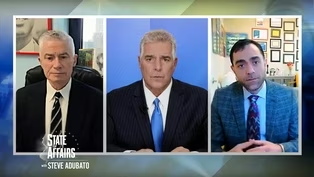
NewThe impact of the criminal justice system on trauma
Video has Closed Captions
Clip: S10 Ep8 | 10m 25s | The impact of the criminal justice system on trauma & mental health (10m 25s)
 New
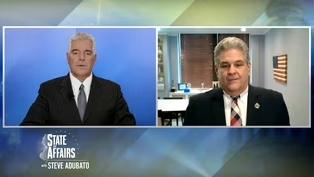
NewPhil Alagia talks the challenges of building a government
Video has Closed Captions
Clip: S10 Ep8 | 9m 15s | Phil Alagia talks the challenges of building a government (9m 15s)
 New
NewRutgers Law School professor breaks down immigration
Video has Closed Captions
Clip: S10 Ep8 | 9m 15s | Rutgers Law School professor breaks down the immigration crisis (9m 15s)
Providing Support for PBS.org
Learn Moreabout PBS online sponsorship New Episode
- News and Public Affairs

Top journalists deliver compelling original analysis of the hour's headlines.
 New Episode
- News and Public Affairs

Today's top journalists discuss Washington's current political events and public affairs.
 New Episode
 New Episode
 New Episode
 New Episode
 New Episode
 New Episode
 New Episode
 New Episode
 New Episode
Support for PBS provided by:
State of Affairs with Steve Adubato is a local public television program presented by NJ PBS